|
Getting your Trinity Audio player ready...
|
Rediscovering the Leader Beneath the Stewardship
Let’s Talk Family Enterprise Podcast Episode #77
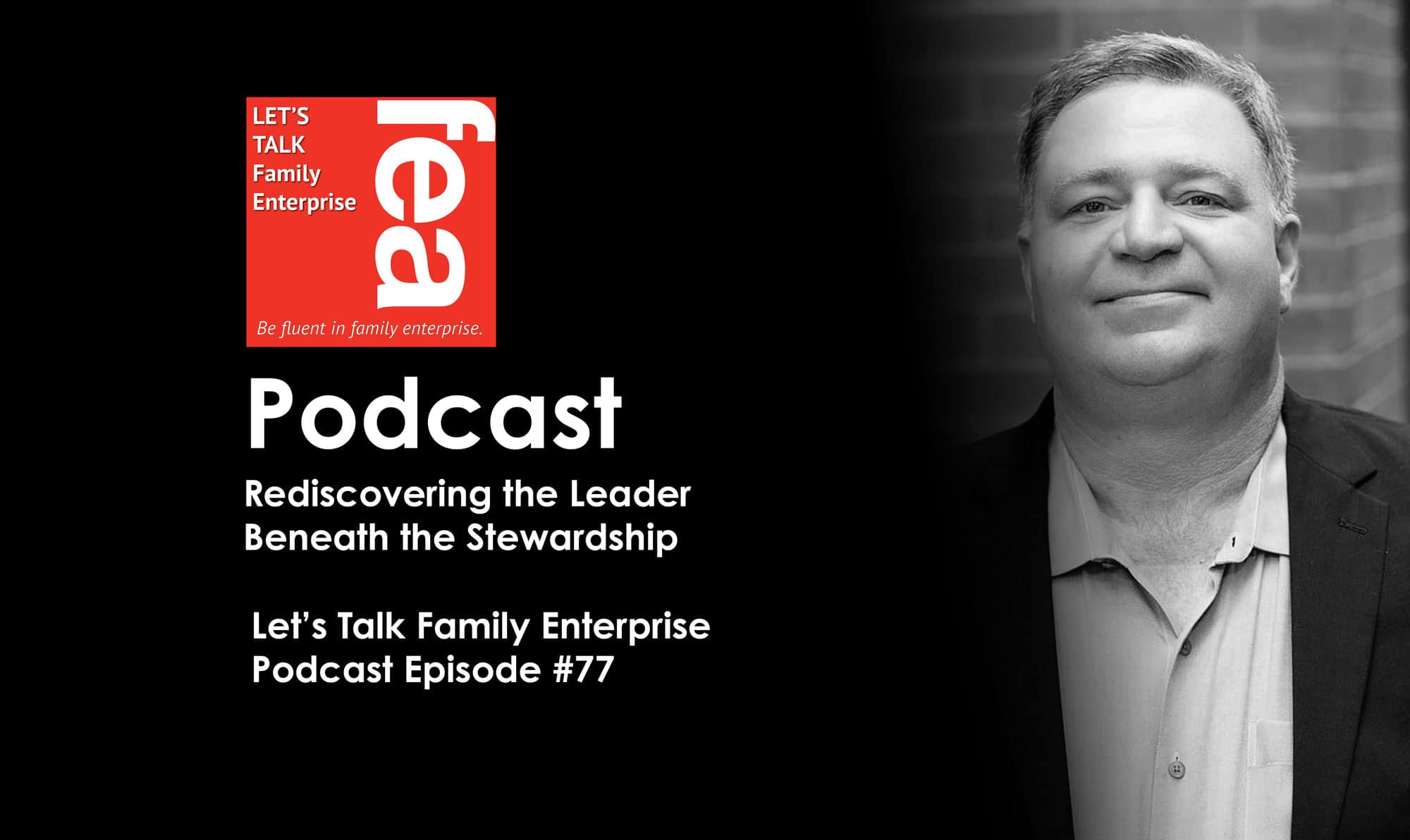
Host: Steve Legler
Guest: Jill Nykoliation
Host Steve Legler speaks with Executive Coach Jill Nykoliation ahead of her Keynote set for Family Enterprise Canada’s upcoming Symposium in Vancouver, taking place May 25-27, 2026. The discussion covers some of the limits of a stewardship mentality, and delves into helping each family member discover their own innate drivers and talents to use in service of the family enterprise.
Transcript
Hello and welcome to another episode of The let’s talk family enterprise podcast. My name is Steve Legler, and I’m honored to be your host once again this month, we’re going to be discussing leadership in its many different forms, and look at how it’s related to the idea of stewardship in the family enterprise context. Our guest is Jill Nicholas, who will be delivering one of the keynotes at the upcoming FEC symposium in Vancouver at the end of May. There, Jill will be sharing her thoughts on rediscovering the leader beneath the stewardship, and so we wanted to spend some time with her to get a jump on that and hopefully wet some appetites for that presentation. Along the way, we’ll touch on biceps and triceps and delve into Carl Young’s 12 archetypes, and hopefully learn a few things along the way. There’s plenty to cover, as usual, so let’s get going. Jill, Nicholas, and welcome to the let’s talk family enterprise podcast.
2:30
Thanks, Steve. It is my pleasure to be here with you.
2:32
I’m really looking forward to this. I used a lot of words in my intro that I want to sort of double click on and the word stewardship, which is a word that a lot of people in the family business space are familiar with. And I personally think some people think it’s kind of like the gold standard, but that for some people, it leaves a lot to be desired. What are your thoughts on on that word stewardship?
3:05
I absolutely agree with you, and I hear it a lot too. Stewardship. I also hear it with duty. And in there is also responsibility and loyalty and obligation. And all of a sudden, when you start putting those other words around it, the gold starts to go, oh, wait, is this the gold star? This sounds heavy. This sounds heavy. This sounds like fall in line. This sounds about how was it done before? And we go, Wait a second. I thought we were talking about leadership, and leadership is about authenticity, and leadership is about looking forward, and stewardship is beautiful, and it can also be heavy. And I think that’s where I look and go, Wait. Is the gold standard? Is it? Wait? What did he mean by that?
3:55
And I guess it depends on what generation you are in the family business, and it’s often the ones who are the ones who have built something, would love to see it be stewarded, and would love to have people continue what they started. But these days, when the world is changing so fast, to expect anything to continue the same way for years, decades and generations into the future is a little less realistic than it might have been a century ago, when one Shoemaker passed on his business to his son.
4:27
And there are parts of that to your point that can be helpful and parts of that can be harmful. Because if stewardship is flexible, yes, but often we mean stewardship, and it has more rigidity than it does fluidity, is my experience.
4:46
So I guess part of what we’re going to be talking about in Vancouver in a couple of months is how to change the way people look at stewardship and make it a little more flexible and a little less rigid. Is that kind of part of where you’re going?
5:01
Yes, and I would add to that, how about a little less? One size fits all.
5:06
Okay, so the one of the nice things about families that go to symposium is they meet other families. And so often these families, if they’ve never been to symposium or gone anything, they think their family is the only one that’s going through something, and then they meet other families and realize they’re not the only ones. But I think you can then take that too far and think that, oh, well, we’re all there like students in a classroom, and we’re all supposed to learn from the people at the front of the room, and there needs to be a lot of customization in each family’s stewardship or not? Or what does stewardship look like in our family?
5:45
Question, yes, and that’s where I start going, well, we want stewardship, but also don’t we want great leadership? Because great leadership will include stewardship. So that’s kind of the hierarchy is, is leadership and ingredient to stewardship, or stewardship and ingredient to leadership? And I think it’s the latter of which you go. Because what is I need a great leader to run, to lead this business, and I need a great leader to do what’s right for this family legacy. Because if stewardship is the guy then staying still, or you might have blind spots, or you might just come in constraint and going, Okay, well, I got to fit this mold, and this is the way it’s done. And where I get really interested as an executive coach is I hear what I hear a lot is I feel flat, it looks like I’m doing fine. And of course, I love this family business for all the reasons that I’m supposed to, but I feel stifled, and I feel flat, and there’s parts of me that have long not been alive. And if we heard that say our next generation, saying we wouldn’t wish that for our next generation, we wouldn’t wish that for ourselves, but that’s the thing I hear so often. Is not alive. And I do know what I remember, what it’s like to feel alive, and this isn’t it.
7:16
And I you want to bring
7:19
people back to that. And I just want to, like the first word in the title of your workshop is rediscovering, and it’s sort of like an invitation to sort of go back and look at something in a new way. But then the other thing that strikes me is that we’ve been talking you and I just now these last few minutes, about leadership, and the word is rediscovering the leader so it’s the more individual. So what does leadership mean to this person? And you are highlighting a feeling that I’m sure some of the people in the audience will be familiar with, which is, I feel like I’ve been put in this box to play this role in a way that maybe worked for someone else or worked at another time, but it doesn’t feel like it’s right for me,
8:07
right, right? And as I work with leaders and family enterprise, it’s also what if it’s okay if someone in our family doesn’t want to go in the family enterprise, is that okay to say? And how can we go, oh, I embrace that, because you’re wired a different way. And, oh my gosh, this would be constraint. Go fly and be you, like, there’s also room for that conversation in our next gen saying, like, who’s actually wired for this? And it’s not that’s this is a hierarchy of those who are and those who aren’t. But what if we wanted for each of the next gen, or even current gen, to go I want you to thrive and soar for who you are and how you’re wired, and if that means in the family enterprise, then let’s make that be true inside too. And if it’s not, that’s okay. But now we understand the different wirings, which is why I love Carl Jung’s work so much, because many people here were listening. We’ve done Myers, Briggs, we’ve done Enneagram, we’ve done all these things. What I like about Carl Jung’s work? He works in archetypes, and if anyone’s listening, going, who’s Carl Young? Carl Jung is a Psych was a psychoanalyst, very famous one from Austria. He shaped psychology in a lot of the ways. If you know introvert and extrovert, you know his work. If you know the word synchronicity, which is like a meaningful coincidence, like, Oh, I was thinking of you, that’s his work. And archetypes there he did work globally. And said there are ways that go cut across cultures, geographies, religions, of how people are wired. And he has 12 of them. And what I like about that those, versus, say, the personality test, which we listen and we’re in our head going, Okay, I’m seven with a shadow of four. What was that again? And I’m, I’m for your listeners, I’m tapping to my head, my Oh yeah. And I’m totally processing this in my brain versus or Myers, Briggs, break on ENTJ, like I saw again, my two, my J is a two, but, you know, we’re in our head, but that’s not our being, that’s our logic. And what I like about archetypes, and I use that as a brand strategist for 30 years of my career. I use that to go, what’s the narrative? These are narrative constructs. What’s the story I tell myself? What’s the, what’s the what’s the mission of this narrative? What’s the shadow side of this narrative? What’s What am I different strategies that’s more intricate. People go, oh, that I recognize. And what I mean by that is, am I the sage? Am I the kind of person my wiring requires me to oh, I need to. I need to understand. Before I can go forward. I need to understand. How do we build this? Let’s deconstruct it, to reconstruct it. Now I can go forward. Or is it that I’m the Explorer? I’m an adventure. I need to fling myself out. I love trying new things. Always come back, but I love to go on adventures, and that includes in the business, or am I the Outlaw? Which I go? I can’t help it. I look at everything upside down first and see if we’ve looked what if we look at it the other way. And these are, these are just three examples of the 12 going each of us are wired with a dominant one. And when we get into and then, what if we brought that into our leadership style? Because we say, Oh, be authentic. Okay, authentically.
11:34
What so, so you are using Young’s 12 archetypes as a tool to help individuals figure out their own wiring in order to sort of deconstruct themselves or take a step back and then looking at their Ways of leading or having a fulfilling life, correct from that perspective, which most people have not done. So that’s the exercise you’re going to be bringing people through in Vancouver, or part of it.
12:12
We are going to do that in real time, all of us together, all of us together, and also all of your generations, whoever’s listening. We’re going to do it together and go, How is mom wired? How is brother wired? How is dad wired? How is sister wired? Oh, goodness me, we are. This person is a rebel. This person comes at it. Let’s say as the hero. I need to save the day. I love saving the day. Now there might come as an everyman, going, No, we’re all in this together. And go, oh, what I mean by that. So why is that important? Because when that primal wiring inside of us isn’t allowed to express itself, we feel flat when we have to conform into a box. And if you guys, if you your listeners, could hear me, see me. Now, take my hands and I’m like, putting myself into a box and tight. Go, okay, what does stewardship look like? Responsibility, duty? Those are all tight conforming words, right? But if I say, if I want to lead authentically, then I might go, oh, then I’ll send my arms. Get why go? Well, let me tell you, like I love seeking out innovative roots. That could be the adventure. If that’s an archetype, you go, Oh my gosh, that person who’s wired for adventure and experimentation might be exactly what we need right now. What if we told them it’s okay to be that? What if our industry is being disrupted. What if we knew in the family who’s the natural disruptor? We could use some of that right now, whether you’re in charge, but just when you contribute, be you, and what if I honored the way you are, because we need that right now, versus going back to the beginning of our conversation, stewardship, duty, responsibility, those are very conforming, but that’s not how we expand. It’s not how we grow. It’s how we
14:10
stay boxed. So you will be helping people go on a journey of self discovery, but in a group of people that will include, for many of them, family members, so they will be discovering truths about each other together, which hopefully arms them with some ideas of how they will move forward together. Is that kind of whatever,
14:39
and I love the word marvel when you see this and when we do this together, when people it’s often we can see other people’s even faster than we can see our own. Because there’s a Chinese proverb, the fish are the last to discover the ocean. What’s what I just swim? I don’t know what you’re talking about, but we go, oh, that fish is in water. So we can see each other’s, which is why it’s gonna be helpful to do it in the presence of of our own family members and then our advisors. And when we understand like, oh, wow, you’re so wired that way. And it’s be the here’s your wiring, here’s your here’s your strategy, here’s the different ways it shows up here. If you over flex. It might when you over flex, this is what it looks like, too. So if we all have that in us, and so when we know that, then I love the word Marvel. Think of marvel at it going, oh my gosh, I’ve you. I actually know this about you. You’ve been like that since you were 1218, I saw it at 32
15:41
So are you saying that we can expect that some people might have difficulty putting their finger on their own type, but maybe some of their family members will all be pointing that at them? No, you are such
15:59
a nodding your heads, and the person I think most people will see there, so I and that’s why you and I put bicep and tricep, and we’ll go to that most people will see, like, I got a couple that are speaking to, yeah, and some people, we will see other people’s clearly, because, you know, someone comes to you like this problem, and you begin with it. And how did you see that? Because you’re not in it. So it’s like that. It’s like that. But you would typically, people typically do see their their own will get two or three. They’ll kind of workshop that. And that’s where I say bicep and tricep comes in. What I find fascinating is we often have a way of being that is trained, rewarded, and so it gets stronger and stronger and stronger, and we go, that’s who I am. We go, No, me, maybe, but a lot of times, that’s how we’ve been trained. We’ve gone to leadership training, our performance reviews, what gets applauded in the press or in the family,
16:56
we’re doing what people what we think we’re supposed to be doing, because everyone’s been telling us that that’s what we’re supposed to do,
17:03
and that’s what you’re good at. And so now we go, okay, then we start over flexing. And I call that the bicep because I’m pointing I’m tapping my bicep, for those of you wondering what I’m doing. And you go, yeah, and I can flex that all day long. And we look at that, we even say to a little kid, how strong are you? We always go, or anybody. You hold up your bicep. You go, yeah, because I’ve trained it, I’ve trained it, I’ve honed it. And it might be partly true, like might leave you, but it might actually be over developed. What I find when people go, there’s two here. There’s something like a whisper of this one, I think might be me. I call that the tricep. It’s at the back of your arm. And you kind of go, oh yeah. This thing back here that when someone says, How strong are you, you flex your bicep. But we never go, oh yeah. Want to see how strong I am. Check out this tricep. No one says that, but it’s there. And what I love, Steve. So one of one of my students actually said this to me in one of the classes I teach. Is they said, you know, the tricep is two thirds of the arm gel. And I love that even more. Yeah, this is how we stabilize our
18:14
your hidden strength that nobody talks about, but that’s actually bigger than the one that you’re
18:19
actually, yes, exactly. And that’s the one often, the itchy one, the one that goes in kind of flat. It’s because our tricep is like, Can I can I flex a little bit? Here? Is it time yet? And so I find with with that is, what if we brought them all to life, and not just the one that gets appraised, praised and awarded, but the one that gets itchy, that feels flat, is because it’s the part of us that goes somewhere along the line. I either learned or was told this isn’t welcome here, and I put it away. You know, you’re super creative. This is a finance driven role. Put your creativity aside. We don’t do that here, or all this. Just you’re always looking at you, always flipping things around to use the disruptor again. Just stop doing that. It’s irritating. Just fall in line. That sense of that your tricep gets put away, but eventually goes. But this is what I naturally do. It’s how I naturally think. And what if you’re deeply hearted, but this is a business where it’s just the facts. Let’s just you know, like all business here, what if you are the impassioned lover archetype, which is the hearted one? I feel people I’m really good with, sensing things. I love deep connections that one might go. What if that’s not welcome in the family, but that’s who you are. It becomes very lonely, for example. So that’s where you look and go, Oh, wow. But if we were to look at our our family, we would never knowingly shut any of these things down, right? We also say to our kids, just be you. But I’m nervous I’m going to a new school. Be you. Just be you. Everyone will love you. So we say this, and at the same time, we also have these scripts of what does success look like in this family, and they might not match. Just be you might be true in the school yard, but when, if you come into this family, we are like, we have loyalty above all else, we humor has no role. This is all about finance, or this is about status, or in that’s where this authenticity versus attachment piece comes in where we don’t mean to, but often, very often, we do. And that I love about this exercise is it kind of brings it out going, Wait a second, back to authenticity. Who am I?
20:51
And part of this and the beauty and the complexity that comes in when you’re dealing with business families or family businesses, and those are not necessarily the same, but they’re, you know, are you a business family or a family business? In a business, it’s a lot easier to say, well, this is what we do here, and this is what this is about. And so excluding people or whatever, because we only do this here in a business, is easier to do. But in a family, I don’t think most families want to be excluding people from the family because of the way they are, so that like, which circle of the three circles are you in? Your answer may be different. And sometimes some some families come to the FEC symposium thinking about, we’re going to learn how to have a better business, and then they go home realizing, Oh, we learned how to be a better family, and maybe 8,000%
21:53
and I think that’s so beautiful, what you just said. Because before we can be a great business, we need to be a great family. Because our ethos is in here, and we want it in here, and so in order to be a great family, do we actually truly know and respect and marvel at each other’s wiring
22:15
and give people permission to bring their best selves, whichever role they’re playing in the family or in the business, or both,
22:27
or both or neither. Like, that’s where I was talking to a leader of a multi generational family we did this work together. And he said to me, was like, Oh my gosh. It’s so clear to me now why I do what I do, or my approach. Now I have words and I can actually explain myself to the others. This is how I’m wired. This is why I always go here first. And he said for next gen, this is why. Now I can also see two of the four shouldn’t enter this business. It will stifle them, because we don’t actually have room for what, for how they’re wired, and it’s so beautiful, this will stifle them. And so now I go, Oh shoot. We shouldn’t bring shame to that. Why you’re not cut out for it. We should actually be cheering them on. Go Thrive wherever it’s best for you. Is also, I thought that was brilliant. He came to that conclusion, going, Oh, wow, so who they are. There isn’t a lot of room here.
23:24
Now. What do we make of that? And how do we help that person as a family member that we love, to find a way for them to have a career where they are doing something, where they can shine, can thrive, and people can marvel at
23:44
them Marvel. And if we need what they’re so uniquely good at or wired at that isn’t here full time, maybe if we need it from time to time, could you come in and because I know you are part of the family legacy, and the stewardship is still going to be there, but maybe we allow for it in other forms or intermittent forms,
24:03
how to tap into each person’s wiring and strength as and when needed in areas that are not always needed. So the difference between being an employee versus being someone who’s on the board or who’s on a committee or who’s running the family council who has no strengths. There are all sorts of needs for different types of people, and consciously trying to find the right places for the right people is almost always a worthwhile effort,
24:39
always and in the right part of the cycle. Where are we in the business arc? Or where are we in use? You said at the beginning, everything is changing so fast. Well, let’s say we had a disruptor, or we had an explorer type wiring. They’ll be great in this moment. They love trying different routes. They love looking at things upside down. Do we have one of those? And maybe we’ve told them that’s not you, not that welcome, because in a past cycle that we didn’t need that it was steady, steady. But what if we gave those in the right environment different things come up, like the impassioned and lover or the every man, which is about I really connect well with people. People really see me as one of them. If you have a strong human culture, or, let’s say, you need to redo your culture or reshape these people have their finger on the pulse. It’s intuitive. It’s almost magical to watch them where other people might be more distant from their employees, and you go, Oh, you know, what? Can you be on this project with me, or I’m gonna I know I’m the lead and you’re the VP, but
25:44
you actually get this better. Yeah. So finding ways to bring people in, not only in the right place, but you mentioned the right time, and I’m wondering that that leads me to a couple of questions, like, do people go in different phases of their life from one to another, or do they are they basically baked into one of these types.
26:08
Typically, we’re typically, we typically lean into these, the ones, especially our tricep that’s almost found you go, go back and explain. Go back and tell me how you played, tell me the role you had, yeah, but our bicep one gets developed through training, okay?
26:28
And between, when you do this with the family, with people from different generations are there, oh, well, he’s this just like dad, or she’s this, just like mom. Is there some hereditary part of this, or is it more random? Because I know that so often, oh, well, which one of the kids is going to take over the business? Well, let’s choose the one who’s most like dad, usually or mom, right? And that becomes the fault, which often by the time that person, two or three decades later. It’s, you know, the business is very different in its evolution, as well as society.
27:07
So, yeah, it’s a combination, to answer your question. It’s a combination, but most often it’s different. We’re actually different. We choose to see them out there just like me. Yeah, maybe their model they’re modeling after you, doesn’t mean they are like you, they just learn how to mimic you.
27:23
Yes, yes, they and there may be different reasons why they have learned to express their similarities to someone, because there is some sort of reward, or expected reward for doing so, but when that’s not authentic, going back to the word you were using for it can it’s not as it doesn’t last as long.
27:50
It’ll catch up with you somewhere. It might catch up with you in your 30s. It might catch up with you in your 60s, but somewhere you’ll go. This isn’t me, and no one else. I don’t think anyone else knows that I’m flat and unfulfilled, but I know, and I can’t fake it anymore, and there’s no amount of extracurriculars that is going to fill this void, because I’m somewhere this has run its course, and that I hear a lot.
28:21
So the extracurricular, so you’re, you’re, you’re hinting at what I’m pretty sure I know, what you’re talking about is I can have this job that I think my way through, and I content myself with fulfilling the things that I like to do outside of work. But wouldn’t it be nice to not have to do that? Correct? Let’s find ways to do it as part of it correct.
28:43
So I’ll use a really easy example for people listening like, what if being an explorer is part of you? I just love to try different routes, and I, like a lot of innovators, I like that. But what if duty was really what we the success script in the family is fall in line, duty, responsibility, stewardship, and we go, okay, I can do that. There’s no amount, no amount of trips to Japan and Costa Rica that are going to eventually scratch that itch. And so, so that’s where you have to go, Okay, what if I could do that in the role? What if I could do that in a role, and I could have that sense of been 100% fulfilled? Does it have to be a zero sum game? And so use that as an easy example. But what if I was really people centered, but this is a really, you know, more of a ruler type family where, like, no, no, we are the charge, and those are the employees. Maybe no one has that anymore, but, but you go, what if we’re we actually are told to be distant. If I really love human connection, that’s going to be difficult and inauthentic for me, right? And what if we made room for that? And what does that give? Because each of the archetypes, and we’ll go through them, each of them are valuable, which is yours, and almost always there’s one. Actually, I’ve never, not met anyone who hasn’t quieted one out of the best intention of our environments, we learn what’s welcome and what’s not welcome, and we twist and we fold and we shut things down, and then we forget to go back and get them. And what I’m saying in this is, what if you did go back and get it? How would that help your business thrive and to your point healthy? When you know yourself and your family marvels at you? I love the word Marvel because it’s just like, wow. We are so different. What he just said that, wow. And then what if you if there was room for that in the business, then what would our business be capable of? Because we’re not coming in as parts of ourselves. We’re coming in with our full, expressive self more often,
30:57
because too often, we are creating a role in a business and then trying to shove a person into that box, as opposed to what I guess you’re espousing, is that we look at what who the person is, and maybe modify some roles, or find the right roles for the people so they can thrive. And when everybody is thriving in a way that is authentic for them and is consistent and coherent with their wiring, everyone in the family and the business ultimately will do better correct.
31:40
We want our businesses to thrive. We want our families to thrive. We want our kids to thrive, we want our partners to thrive. And I think in the what I found is somewhere along the line of accomplishment and prestige and reputation, sometimes we forget what to ask the great what makes you thrive?
32:03
Yeah, you kind of get into a rut right as you’re just going through the motions, and you don’t want to admit that you’re not happy. And so you can fake your way through years and decades, but eventually it will catch up to you and and doing such an exercise with the family. I’m imagining will be very powerful for someone in the family who’s scared to admit to one other person in the family something, but when there are other families that sort of give it permission and give it space, I could see how this could be very powerful. And I’m looking forward to this your session, much more than I was a half an hour ago. And we started,
32:46
well, good. I well, I find and I love doing this, because watching people’s faces go, well, darn, I now have language to describe myself. And I kind of thought, aren’t we all the same, especially in family enterprise, we kind of all are. This is the way the family is. We have a way of the family. What I but I promise, actually, I literally promise the people listening, is they will go home still talking about this with each other, going, that’s what, that’s what’s going to happen, and go, I will come home with a new dimension of understanding and marvel of each other and go. Why wouldn’t we want our authentic selves in the business?
33:26
Beautiful Jill, this has been great, and unfortunately we need to wrap it up. We’ll switch over to our final two requests that we have for all of our guests. One is a book recommendation, and the second is one piece of advice. So can we start with a book recommendation for our listeners?
33:44
Sure, I’ve got two. I’ve got one for the current leaders, I would say the book I would recommend is from strength to strength, by Harvard professor Arthur Brooks. Must Read This talks about how your brain changes in your 40s, what motivates you, what lights you up and what you are good at. Changes in your 40s. Go with your physiology. Go with your wiring.
34:07
Put a link into that. And I’ve read that book and also recommended,
34:10
okay, the second one is, yeah, for rising, Jen would be working identity by Professor Herminia or Bara.
excellent. It’s about, really, how do I figure out what I like and what I’m good at, and how do I clarity comes from Action. Action doesn’t come from clarity. And she gives amazing exercises for for the younger generation to go. How do I start experimenting so I get my authentic identity out? So it’s fantastic book because it’s, it’s just great, great exercises clarity comes from not the other way we think about it. I can sit and I can sit and think, What should I do it?
0:15
0:54
You go, Oh, that wasn’t nearly as much as fulfilling as I thought. But I won’t know it until I do it. I can sit and think, and I can tie myself in knots, and I will, I will be stuck, but just try have a conversation, open a door, shadow someone, go and do, come back and tell me what you learned. And now we’ll take another step. That’s, that’s what that looks about, all right, one piece of advice for families, or advisors to families, or both, whatever works, be you, be you, oh, that’s five letters two words, yeah, one of the hardest things we can do, though, because we, by the time we get cooked and we’re in our 20s, 30s, let alone Our 60s and 70s, we are often so distant, and so either we take ourselves for granted, so we can’t articulate it, or we’ve been so many different things for different people, or we fit into a mold. I actually don’t know who I am. I know how to describe the mold I became, but I actually don’t know who I am. So what I got squeezed into the bowl. That’s exactly right. So I it’s very simple. He said, Be you. But that’s the work I do with people. Is like, wonder who that is. Because when people say, you know, be authentic, I always say, when I also did brands, brands would come to me and say, make me an ad that’s authentic. I’m like, okay, authentically, what?
2:24
And I’d be met with crickets every time.
2:28
So forcing, forcing people to sort of reconsider and think and go back to their simple basics, yeah, something you’ve been there knowing, in there, in in the knowing, in the ethos of who you are. And that’s the that is the workshop is we will eat. People will leave with that and go, Okay, now, you know, and now you’ve got articulation for it. It’s it. People always go, I just feel seen. I actually feel excited. I I back to like, I’m going to reconnect with myself. Like, wow, I forgot it was like that, and it’s still there. It doesn’t go away. Jill, this was fantastic. Thank you so much for joining us and wetting our appetites. I’m sure there will be people circling your session on their programs and waiting for it, and then I bet you they’ll still be talking about it just like you promised as they leave. Thank you so much. Thank you listeners. If you have not already subscribed, please do so to make sure you never miss any of these monthly episodes. Thanks again for joining us. I’m Steve Legler, until next time, if you enjoyed today’s episode, you can subscribe to us on Spotify, Apple podcasts or any other podcast app, and don’t forget to share this episode with family, friends and colleagues.