Here We Go Again (Sorry, Not Sorry)

When you intentionally put your thoughts into writing every week, and you’ve been at it for over a decade, you end up recycling ideas that you’ve raised before.
Occasionally, you think you’ve come up with something novel, only to realize that you already covered it before, and you now have a dilemma.
Of course, there are always new ways to spin something and give it a new flavour, so I normally just press on because something compelled me to “go there”, even if “there” is some place I’ve already ventured.
So, we’re returning to the area of addition by subtraction, again.
See Addition by Subtraction in the Family Business from 2024.
Section 01
An Expression I Love… and Hate
Part of why I felt the need to write about this expression again stems from the fact that I really like to use the “addition by subtraction” phrase.
I’m not sure if it’s because it’s only three words or because of the ironic juxtaposition of the two main words, but it’s become something that rolls off my tongue any time a situation even bears a hint of making more with less.
But because my normal professional playground typically involves people who are related to one another, anytime such a situation even suggests itself, I actually hate the expression.
Whenever the idea of removing a family member is even a consideration for making things better arises, it feels like a failure of some sort.
Section 02
It’s Easier to Ignore It and Hope It Goes Away
As someone who is not part of the families that I serve, my perspective needs to be different, though.
For the members of the family, even a hint at the idea of getting a family member “out” feels like a no-go zone.
It’s so much easier to ignore the problem and just hope that it’ll resolve itself by some miracle.
Alas, hoping for a miracle is not a strategy, as you’ve surely already heard.

Section 03
“They Kicked Him Out Because He Was Too Lazy”
A while back, a longtime friend of mine who works in another field but also has some family business clients was telling me about a particular local FamBiz that he serves.
Not that I asked, but he shared that several siblings were in the process of taking over the business from their father.
He then added that one brother was not involved in this because
“they kicked him out because he was too lazy”.
That line has stuck with me, and I’m not sure why. Perhaps it was said with a certain bluntness that makes it memorable.
I also don’t know if that phrasing is my friend’s interpretation or if that’s how the family members framed it when they told him.
Section 04
Too Many Examples to Count
When I think about families I know where members tried to stick together for the sake of sticking together, I have several examples where they hung on too long.
I even have one where the lawyers are about to be brought in and I may end up eventually being deposed.
Any family that manages to sustain some sort of enterprise over several generations must do some “pruning” along the way, otherwise things simply become too unwieldy.
See Pruning the FamBiz Ownership Tree.

Section 05
Back to the Three Circles Again
I just unwittingly brought us back to the three circles by mentioning ownership.
See Three Circles + Seven Sectors = One A-Ha Moment (from 2013!).
Families need to decide who can and will own the business, as well as who can and will work in it.
But family remains family no matter what, right?
The threshold for being kicked out of the family is certainly higher than the other two.
At a recent FamBiz conference I attended a session addressing exactly, this subject, i.e. yes, you can fire a family member, from the business, but not from the family.
Section 06
The Possibility for Redemption
As I ponder situations I’ve been involved with, I realize that when we enter, we see things a certain way and conclude that someone may seem irredeemable.
I’m in one right now where ideas about how to extricate a family member from the business were top of mind when we started, but now things have changed.
The family, left to themselves, would probably have given up and fired them by now.
But with some intention and effort, we were able to find the right role where they could thrive and add value to the business, for a true win-win.
There isn’t always a way, but you need to try to find it.
If Only So-and-So Would Just…

This week we’re going to look at a subject that’s never far away when families get together and things don’t go exactly according to plan.
We’re going to start with a LinkedIn post from one friend and colleague from California and then include a parable from another in Australia.
We all want everything to go well all the time, and because life happens, sometimes things don’t turn out the way we’d hoped.
So, what then?
Well, in too many families, the first thing that happens is finger pointing to find the one person who is at fault, so we can blame them.
Of course, none of it is ever MY fault!
✦
Section 01
Tech Issues on a Live Webinar
Emily Bouchard shared a story on LinkedIn that she started with what she stated was a line she uses frequently when working with families:
“Everyone is at fault, and no one is to blame.”
I immediately sent myself an email with that quote and put it into my “Blog Ideas” folder for safe keeping for a few weeks.
She went on to explain that she and a colleague had put on a live webinar the day before and where some tech glitches lead to a sub-optimal experience.
She then owned her part of it and noted that she invited her team to do the same.
Doing this requires a certain willingness to be vulnerable and that’s a leadership skill that most teammates appreciate.
She could probably have skipped over the part she played in it and focused on either the technology or some other person.
But she didn’t, because like so many problems, it was actually the result of a bunch of little things that just happened to come together at the wrong time.
✦
Section 02
How Would a Sports Team Handle This?
This got me thinking about sports teams who compete to win every game but always end up losing on at least some occasions.
It can be tempting to point out one person’s miscue, but every game presents many opportunities for someone to influence the result.
After the game, during the coach’s press conference, does he usually call out a single person who made a mistake as the cause of the loss, or does he mention that there were a few areas where the team could have performed better?
What about the players when they answer reporters’ questions?
Every now and then, some will misspeak and call out a particular teammate, and then we never hear the end of the fact that they threw someone under the proverbial bus, even though there was surely lots of blame to go around.
Start the trade rumours, because that won’t play well in the locker room.

✦
Section 03
The Family as a Team? Yes, Again!
A few weeks ago, in On Connection, Belonging and Learning in Families, I brought up the concept of thinking about your family as a team.
There are certainly a lot of potential benefits to treating your family as if they are a sports team, especially if you’re a fan of metaphors like me.
Of course there are other sports comparisons that can be made, and we need to distinguish between everyone being on the same team, as opposed to competing against each other.
As I noted in Kissing your Sister — Playing for a Tie in FamBiz, a family should not be trying to beat each other, and playing for a tie is how a family really wins.
✦
Section 04
A Worthwhile Parable for Families
My Australian friend John Broons shares a great parable about blame in his book, Creating a Thriving Family Business — Progress, Not Perfection.
His story about Somebody, Everybody, Anybody and Nobody is one I even pulled out and read to a family during a meeting I was facilitating with them.
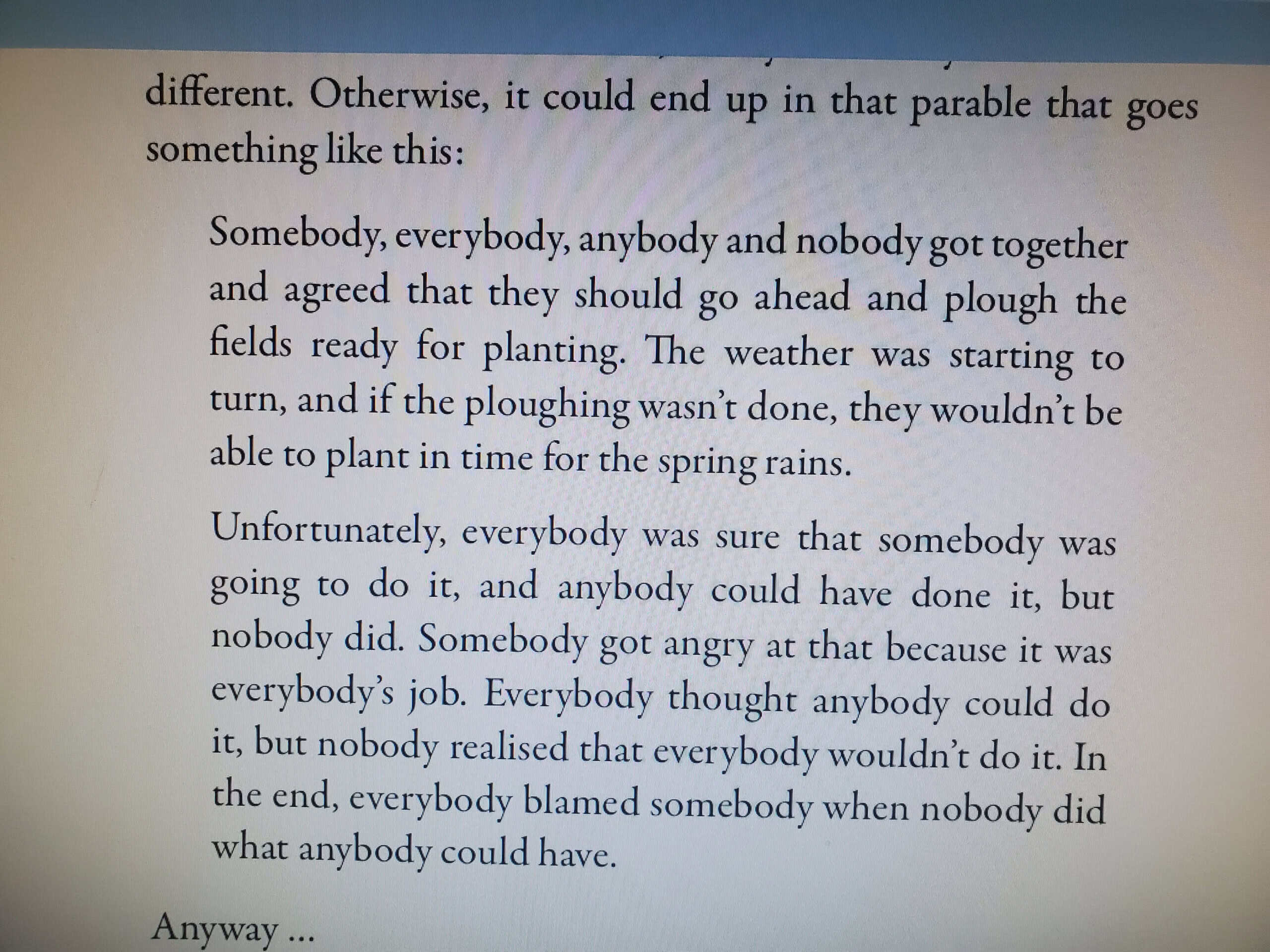
It helped me drive home a point about being more specific when assigning a particular task, lest it not get done and then spark the blame game.
✦
Section 05
Plenty of Blame to Go Around
One of the aspects of trying to find the one to blame that really bothers me is that it’s always backward looking.
Dwelling on how things got where they are and who caused us to be in a sub-optimal place is not productive in getting us out of where we are.
If you want to examine everything to see who’s responsible for a situation, you will probably end up uncovering many contributors.
Can we instead look to the future and how we can organize ourselves so we can improve our situation?
Yes please.

At A Glance
From Blame to Building Forward
Tap each card to reveal the shift.
+Shift IReframe the Fault
“Everyone is at fault, and no one is to blame.” — Emily Bouchard
+Shift IIOwn Your Part First
“Doing this requires a certain willingness to be vulnerable and that’s a leadership skill most teammates appreciate.”
+Shift IIIDon’t Throw a Teammate Under the Bus
“There was surely lots of blame to go around… that won’t play well in the locker room.”
+Shift IVPlay for the Same Team
“A family should not be trying to beat each other, and playing for a tie is how a family really wins.”
+Shift VBe Specific About Who Does What
“Being more specific when assigning a particular task, lest it not get done and then spark the blame game.”
+Shift VILook Forward, Not Back
“Can we instead look to the future and how we can organize ourselves so we can improve our situation? Yes please.”
Everyone is at fault. No one is to blame. Now — forward.
Who Are We Serving, and How?

If you’ve been reading my missives each week recently, you’ll know that I recently attended my favourite annual event (see Coming Down from Yet Another Rocky Mountain High) and that the very engaging and profound sessions I attended have already sparked one recent post. See On Connection, Belonging and Learning in Families.
Now that I’ve processed everything a bit more, we’re returning to some of the thought-provoking wisdom I gathered from the various plenary sessions.
My thinking will surely continue to evolve as I compose these next paragraphs, which is secretly (or not!) why I force myself into this weekly ritual. I hope you stick around to see how I land it all.
Section 01
Walking Alongside, Staying a Step Ahead, Being Available
One of the topics I so often return to here is how difficult it is to describe the work that my colleagues and I do, and so whenever I hear elders in our space share some of their thoughts on this, I jump into note-taking mode.
It bears mentioning that there are some definitions of “elder” that minimize the part about chronological age, and those are the ones I prefer.
For the second year in a row, one plenary session during Rendez Vous ’26 was a Fellows Panel, where three of our PPI Fellows were interviewed to share some of their wisdom, followed by a bit of audience Q & A.
Stacy Allred mentioned that her work involves “walking alongside families” and minutes later Matt Wesley shared that he “tries to stay one small step ahead of his families”.
Later, Wesley noted that a big part of this work is simply “being available” to rising generation family members, which I hadn’t necessarily heard anyone put that way, but which resonated with my work.

Section 02
Rising Gen Paths — Individual Journeys
None of what I shared above is rocket science, but for those engaged in this work it’s important for us to have ways to describe our services in relatable ways.
I appreciated the simplicity of the wisdom they shared and felt better about the fact that I haven’t been missing that much in my own ways of talking about this family work.
Somewhere along the way, either during that panel or another session, I jotted down
“Rising Gen paths are individual journeys”,
and this is where we’ll now pivot.
Again, nothing revolutionary there, but when one works with families, which is complex work, we can sometimes get lost in the idea of finding the right next step “for the family”.
When we concentrate on serving the group, we can sometimes lose sight of the individual members along the way.
Section 03
Human Capital Needs Facilitation AND Coaching
This work is centered around human capital, as opposed to the financial capital. We can’t ignore the money, but we need to focus on it less, because quite frankly, there’s already too many other specialists who are working on that part of the family’s wealth.
Working with the whole family requires facilitation, i.e. helping all the family members have productive conversations that they otherwise will not get around to having, despite knowing that they should.
A huge part of that is simply getting the family into a rhythm and a cadence of meeting together and then holding the space for them so they can speak and hear each other safely.
But facilitating the family space is not sufficient.
That’s where coaching comes into play, to work with each individual human on their own individual journey.
This gets back to the “being available” to the rising gen family members, but it is potentially much more than that.

Section 04
Authors of Their Own Lives — Separate AND Together
As the father of a son and daughter in their mid-20’s, I know firsthand how difficult it is to resist trying to give them guidance on life that they are not asking for, even though they could surely benefit from it.
This is precisely the time where they are discovering things on their own, and that is as it should be.
They want to be the authors of their own lives, not the life that Mommy and Daddy envisioned for them.
At the same time, though, we’re there for the whole family, and the family has hired us to do what we can to keep them all together.
We serve families and their individual human members, and we want what’s best for all of them, as well as for each of them.
All of them, as well as each of them.
How Do These Three Fit Together?

In last week’s Coming Down from Yet Another Rocky Mountain High, I noted that I wasn’t going to share much content from the Rendez-Vous of the Purposeful Planning Institute in that post, but if you’re a regular reader, I’m sure you knew to expect that I’d share some takeaways soon enough.
There was some wisdom shared from the big stage in the opening plenary session, of course, and I’m going to combine that with something I got out of a breakout session that followed.
Next week’s post will also likely combine some bits from different parts of my fulfilling week with so many wonderful colleagues.
If you liked Learning Life Lessons as a Family a few weeks ago, we’re going back to the world of learning once again.
Section 01
Learning With and Learning From
The breakout I attended was expertly led by Nathan Dungan and Jeff Strese, who’ve been part of the PPI community for years, and I’ve participated in their sessions in the past, so I knew I wouldn’t be disappointed.
But with four simultaneous opportunities to choose from, FOMO is always right around the corner at every Rendez-Vous.
They named their breakout “Learning With, Learning From, and Learning For”.
The first two are pretty standard and common, while the third had me saying “hmmm” to myself.
When I work with a family, it’s always nice when I can help create opportunities for them to learn with each other.
When they can also learn from each other, that usually works well too, especially when it isn’t simply “top down”.

Section 02
Taking One for the Team
When they got to the part of “learning for”, I raised my hand because I wanted to make sure I understood where they were going, and I imagined that I was not the only one who might have been unclear on what they meant.
I asked,
“I imagine that the ‘learning for’ is NOT about ‘what are we learning this for’”.
Nathan thanked me for the question and gently noted that mine was actually a “why” question, poorly phrased.
When they talk about learning for, it’s more about doing the learning for the benefit of the family, including the other members of the family.
When I wrote the sub-head above about “the team”, it was to try to emphasize this point.
When a family learns for each other, they are demonstrating a commitment to being part of the family team.
When I can help a family think of itself as a team, I’m cooking with gas, as they say.
Section 03
Connection and Belonging – Great Teams Have These
So now let’s loop back to the title of this blog and the wisdom I jotted down during the opening plenary session.
For a transition of wealth from one generation to the next to succeed, connection and belonging are not optional extras.
They are fundamental to success.
You have surely seen cases where wealth has passed from one generation to another where the successors were not properly connected to the source of the wealth, where that missed opportunity jumps up and slaps you in the face.
Or where those who inherited the financial wealth did not feel like they belonged to the family that created it and therefore struggled to find the meaning behind their windfall.
This is not rocket science, it’s actually pretty simple to understand.
And simple doesn’t mean easy, so it does take intention and effort.

Section 04
Everyone Wants to Be Seen and Heard
For a family to be connected in a way where each person feels like they truly belong, every last one of them needs to be seen and heard.
Most families have at least one member who isn’t really getting that, and they may feel less like they’re part of the team.
I’m not trying to lay blame here, but in the families that I’m privileged to work with, it is something I am always trying to tune in to, to try and nudge things in a slightly better direction.
Facilitating family meetings requires me to notice such misalignment and do whatever I can to make sure that the quieter voices are heard and that each person’s viewpoints are heard by everyone else.
Most families aren’t necessarily naturally good at being a family team together, but if I can help them learn how to be just a little bit better at it, and they can begin to learn for each other, that’s progress.
That’s progress.
My Favourite Week of the Year

I’m starting this post at the Denver Airport on the Friday of another fulfilling week of connection with colleagues, including many who’ve become dear friends.
Regular readers will recognize that I’m referring to the annual Rendez-Vous of the Purposeful Planning Institute, which I’ve attended every summer in Colorado since my first time in 2014.
A Rocky Mountain High is the best way I can describe what I’m feeling in my heart and in my bones after four days of being with old friends and making new ones.
I enjoy most conferences I attend every year, but there’s nothing like the PPI crowd to warm my heart and refill my pitcher.
✦
Section 01
Pouring Out for 51 Weeks a Year
Working in a niche of enterprising and wealthy families is really cool, but since I’m not an accountant, banker, or lawyer, the work I do isn’t easily explained.
So many of the other members of PPI are in the same boat, also working the “qualitative capitals” side of the street.
Because this work is so rarely understood by most of the people we interact with, we all spend an inordinate amount of time trying to explain what we do.
It can be exhausting, constantly pouring out such explanations.
Then we arrive in Colorado for a week of “adult summer camp”, as some have described Rendez-Vous, with our pitchers empty.
A few days later, they’re all invariably overflowing again.
✦
Section 02
Like-Minded and Like-Called Fellow Pilgrims
Last year in Soaking in the Rendez-Vous Experience, Again, I mentioned that those who attend are mostly “like-minded and like-called”.
And this week in the closing panel/keynote, we heard from the venerable James E. (Jay) Hughes Jr., who referred to us all as fellow pilgrims.
I asked my good friend, Mr. Google, for his insights into the term “pilgrim” to see what I could learn from his vast wisdom.
Of his many responses, here’s my favourite:
Pilgrim
“A person who journeys, especially a long distance, to some sacred place as an act of religious devotion.”

✦
Section 03
My Thoughts on this Pilgrimage
Let’s dissect that description a bit for its applicability to the situation that my fellow Rendez-Vous devotees and I are in.
It does feel like a journey, and a long one. There are no quick fixes or short-cuts.
The place we’re all going does seem sacred, although it isn’t really a destination. In fact, it’s not even really our “destination” either, but more of a desire to bring our client families to a better place.
There’s also a lot of devotion involved because many have become discouraged and abandoned the journey over the years.
The word “religious” doesn’t apply for me, but I do know some for whom it’s apt.
✦
Section 04
Over-Functioning in Service of Others
In past years my post Rendez-Vous blogs have shared details on some of the content, but not this year.
You need to experience it to understand, and you can always come next year if you’re intrigued, but we sold out this year and had a waiting list, so don’t sleep on it too long.
I want to share my personal lived perspective.
I set an intention to be service-minded, and, as a long-time member, attendee, and pilgrim, to do everything I could to make first-time attendees and other newbies feel welcome.
I may have over-functioned in that respect, and at one point I was internally admonishing myself for this, especially regarding the two evening, self-directed, open-mike sing-along events.
✦
Section 05
Not My Circus, Not My Monkey — Or Maybe It Is?
These informal, unstructured, evening outdoor gatherings were started years ago by someone who couldn’t make it this year.
Fearing that his absence would make it fall apart to some disappointment, I used my social capital to help make it succeed despite Doug’s absence.
This was not my circus, nor my monkey, but I cared too much to sit back and take the chance that it’d flop.
I’m glad we were able to find and welcome some new PPI rock stars.
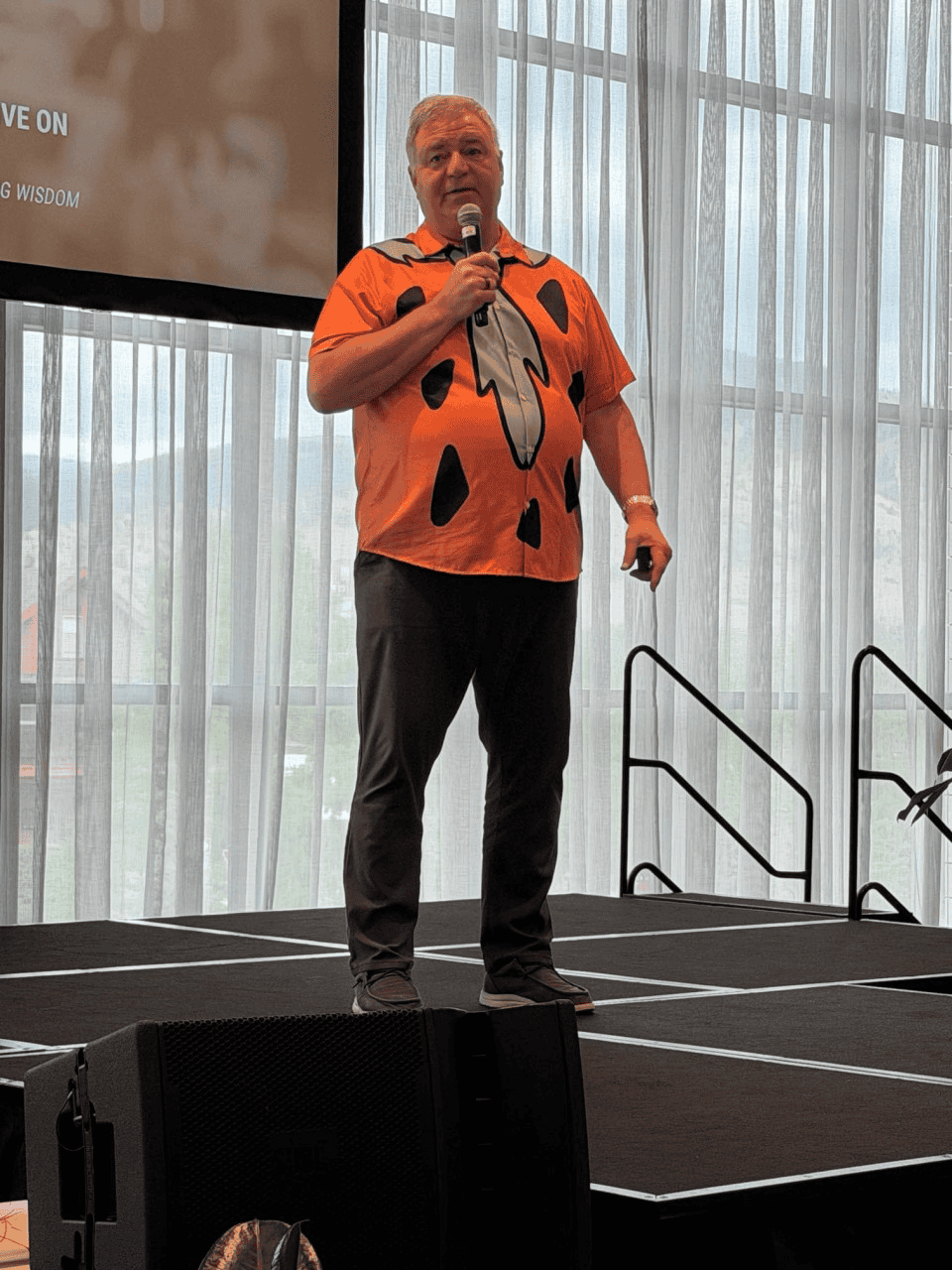
T✦
(Thanks K.K. for the pic)
Section 06
Final Thoughts
Any organization that allows me up on stage with a microphone, in my favourite shirt, every year, is one I cherish.
The FRED Talks were once again a highlight; I worry that we set a high bar for coming years.
Finally, please recall PPI Fellow Matt Wesley’s statement during the Fellows panel:
“Rendez-Vous exists to set up Zoom calls.”
If you want to discuss any of this, hit me up!
See you back in Boulder in 2027.
At A Glance
A Pilgrim’s Rendez-Vous
Tap each card to reveal the reflection.
+Reflection IRefilling the Pitcher
“Nothing like the PPI crowd to warm my heart and refill my pitcher.”
+Reflection IILike-Called Fellow Pilgrims
“Jay Hughes referred to us all as fellow pilgrims.”
+Reflection IIIThe Long Journey
“It does feel like a journey, and a long one. There are no quick fixes or short-cuts.”
+Reflection IVWelcome the Newbies
“Do everything I could to make first-time attendees and other newbies feel welcome.”
+Reflection VCare Enough to Step Up
“This was not my circus, nor my monkey, but I cared too much to sit back.”
+Reflection VIThe Real Purpose
“Rendez-Vous exists to set up Zoom calls.” — Matt Wesley
See you back in Boulder in 2027.
There Are Better Ways to Think About This

Once again, we’re going back to LinkedIn as a source of inspiration for this weekly missive.
Between events I attend, conversations I have with clients and colleagues, and my favourite social media site, these cover the genesis of 95% or more of what I share here.
The post in question is part of a weekly series I’ve been enjoying, from Pierre Dupont, who is several generations removed from the founder of the eponymous industrial behemoth.
His series, Projecting Wealth Across Generations, is full of great ideas and viewpoints.
In a recent instalment, he mused about the dangers of treating a family’s wealth as a “pile of money”.
✦
Section 01
Three Possible Outcomes for the Pile
He shared the following:
“But left without intention, a pile tends to do one of three things:
- dissipate quietly,
- sit frozen out of fear, or
- become the thing the family fights over.”
In the comments, I thanked him for his succinct list, and shared a thought:
“I’ll add that these three results are NOT mutually exclusive, and the pile can end up checking more than one box over time, and #2 and #3 often occur together!”
✦
Section 02
Reality Check from My Dear Wife
As I occasionally do, I bounced my idea for this post off my wife of 33 years, who happens to be part of a family where some of those 3 outcomes may or may not have occurred.
She nodded and said “Yeah!”
I didn’t need her blessing, but I was glad to know that this brief list resonated with her.
I should note that this list is not to be confused with a related one about “who gets your money after you die”.
That one is popular with those advocating for philanthropy, because the three places your money can go after death are: the government, your family, and charity.
But that’s a subject for another post.
Let’s get back to dissipation, fear, and fighting!

✦
Section 03
Flinging Open the Doors of the Brinks Truck
Let’s start with the fear of dissipation of wealth.
Here’s an analogy I’ve used with a family I’m working with, who’ve experienced a recent liquidity event.
See Integrating the Wealth into the Family.
I explained to the rising generation that their parent had spent several decades building a wealth creation engine, but they are now faced with a brand-new challenge that they hired me to help them work through.
It was as if that wealth creation engine had suddenly transformed into a Brinks truck full of cash, which has now landed in the family’s backyard.
Now the parent isn’t going to suddenly fling open the doors of that truck and invite everyone to help themselves to this “pile of money”.
They are also not going to say, “Hey kids, look at MY cash, you’ll get it when I die”.
Making the financial wealth freely available will surely see it dissipate.
✦
Section 04
Frozen Out of Fear
What sometimes occurs when the fear of dissipation is too great, is that the financial wealth gets put into complex trusts or other structures to make sure it doesn’t get frittered away.
That’s the other extreme of the continuum and isn’t necessarily a much better result.
The wealth creator has often ended up in an unforeseen situation of suddenly having more wealth than they need, but they also don’t want their hard work to blow away into the wind after they die either.
There are plenty of professional advisors out there who know how to structure wealth in ways to make sure it lasts forever, and clients can easily be swayed by their arguments.
✦
Section 05
Family Fights Over Money Are Not New
Families with a great deal of wealth have been fighting over it for centuries and estate litigation is one of the fasted growing areas of the law for attorneys.
This will not change anytime soon.

✦
Section 06
The Secret: Avoid the “Pile of Money” by Talking About It
The best way to try to avoid the extremes of dissipation of wealth and freezing it out of fear, and all the fighting in between, is to have the family discuss it openly.
This needs to be done over time, on a regular cadence.
See Ideas on Dealing with the Family CRAP.
It isn’t just some undefined pile of cash.
It needs to become something the family co-creates, along with a purpose and mission and a strategy to have it fulfill its and the family’s potential.
Progression is often slow, and that’s even better.
See Your Family’s Continuity Journey — Progress or Paralysis.
Get help and get started.
At A Glance
The Three Fates of an Unmanaged Pile
Tap each card to reveal the fate — and the way out.
+Fate IDissipate Quietly
“Making the financial wealth freely available will surely see it dissipate.”
+Fate IISit Frozen Out of Fear
“The financial wealth gets put into complex trusts or other structures to make sure it doesn’t get frittered away.”
+Fate IIIBecome the Thing They Fight Over
“Estate litigation is one of the fastest growing areas of the law for attorneys.”
+AlsoFates Are Not Mutually Exclusive
“The pile can end up checking more than one box over time, and #2 and #3 often occur together!”
+The Way OutCo-Create Purpose, Mission & Strategy
“It needs to become something the family co-creates, along with a purpose and mission and a strategy to have it fulfill its and the family’s potential.”
Get help and get started.
Teach Your Children Well

There’s a trend in my field that I’m noticing around the idea of learning, where the concept of having a “learning family” seems to be in vogue.
I think that families that can get all the way there will be well served by this type of thinking, and yet I know most families will never get there, and the majority of those are simply not realistic candidates for it in the first place.
I have some friends and colleagues who label themselves as “fractional chief learning officers” for families and I wish them well because that sounds like a very rewarding career.
My work is typically done “upstream”, as in, way before a family can even begin to consider themselves a learning family.
But the idea of having the family learn together is usually not far from the work I do.
✦
Section 01
Left to Themselves, What Do Families Do?
As someone who plies his trade as a resource to families, I often find myself talking about what happens to families who choose not to engage an independent outsider like me to support them.
I help families have the important conversations they know they should be having, but, left to themselves, they aren’t having.
When families are left to themselves, lots of things that need to be done don’t even get put on the to-do list.
Okay, this was supposed to be about learning, wasn’t it?
Yes, sorry for the diversion; and when you think about learning, you almost automatically think about teaching, the other side of the same proverbial coin.
In a family, there’s a natural tendency to think that the parents should teach and the children should learn.
✦
Section 02
Is “Adult Children” an Oxymoron?
Parents as teachers and kids as learners works well when the kids are still children.
In most of the families I work with, those “children” are now adults, which some people call adult children.
I’m familiar with a quote that states that “adult children” is an oxymoron; they’re either adults or they’re children.
I like the contrast this paints.
Let’s use that contrast to highlight the fact that once they’re adults, the ways that learning and teaching happen need to be updated to reflect the adult-to-adult relationship reality that now exists.
Families can and should begin to learn together, and the idea that learning only flows in one direction, i.e. “top down”, needs to be scrapped.

✦
Section 03
I Want to Teach You a Lesson
We’re more than halfway through and I have uncharacteristically not yet shared the genesis of the idea for this post.
Alas, we’ve arrived.
In a family I’m working with, I’ve got a situation where a parent wants to make sure one of their offspring learns a lesson from something they overlooked about a decade ago.
As their family advisor, I agree that this young adult would do well to understand their misstep and learn a lesson from it.
The problem I’m wrestling with is that there’s a parent who seems to want to use this occasion to “teach them a lesson”.
And that has a very different look and feel, along with the sub-optimal consequences I fear it will entail for their relationship.
See also Questioning Someone Vs. Asking Questions.
✦
Section 04
A Difficult Attitude Adjustment for Parents
The old “I teach, you learn” the parents used when the kids were actual kids stops working for them at some point and begins to work against them.
Getting those parents to recognize this is often one of the most difficult parts of my work.
Thankfully, some begin to get it and make the necessary adjustments, but some don’t ever get there.
See On Sovereignty and Self-Righteousness in Families.
There’s something I eventually remind parents of when they’re stuck here, and it’s about looking to the future instead of being mired in the past.
✦
Section 05
The Almost Inevitable Eventual Role Reversal
When your children were babies, they relied on you 100% for food, shelter and even cleaning up after their natural bodily functions.
If you live long enough, that script will eventually flip, and you will be the one relying on them to oversee someone taking care of those things for you.
If that script flips abruptly, you may not like what you reap.
In an ideal circumstance, there will be a long period (decades) where the adult-to-adult relationship is relatively horizontal, and not “one up, one down”.
You can all learn together, from each other.
At A Glance
From Top-Down to Horizontal
Tap each card to reveal the shift.
+Shift IHave the Missing Conversations
“The important conversations they know they should be having, but, left to themselves, they aren’t having.”
+Shift IIScrap “Top-Down”
“The idea that learning only flows in one direction, i.e. ‘top down’, needs to be scrapped.”
+Shift IIILearn a Lesson, Don’t Teach One
“That has a very different look and feel, along with the sub-optimal consequences I fear it will entail for their relationship.”
+Shift IVRetire “I Teach, You Learn”
“The old ‘I teach, you learn’ … stops working for them at some point and begins to work against them.”
+Shift VPrepare for Role Reversal
“If that script flips abruptly, you may not like what you reap.”
+Shift VIGo Horizontal
“The adult-to-adult relationship is relatively horizontal, and not ‘one up, one down’.”
You can all learn together, from each other.
Not Something to Check Off a To-Do List

This week’s blog comes from the combined inspiration of a couple of posts I came across on my favourite social platform over the past few weeks.
As I consider their authors, it strikes me that one is from a man and the other from a woman, one is from the US, the other from overseas, and one is from a Gen-Xer and the other a Millennial (OK, I’m guessing ages here).
I believe diversity is a strength, as regular readers will recognize.
So, I saw an opportunity to combine these inspiring missives into one of my own, and now we’ll see if I’m up to the task. Wish me luck!
✦
Section 01
Invitation or Interest? (Chicken or Egg?)
Taking the posts in the order in which I saw them, Andrew Pitcairn shared some thoughts on engaging the rising generation in a family enterprise context.
He nicely sums up a familiar refrain that so many of us in this field are familiar with:
I hear it constantly from senior family members: “Why isn’t the next generation interested in the business? They just don’t seem to care.”
And from the next generation? Almost word for word: “When will they finally make room for me? Don’t they see what I could contribute?”
Even if you haven’t seen this, you can certainly see the challenges this poses in any family enterprise situation.
He adds: “Two sides. Same longing. Zero conversation.”
As a fourth-generation family member who also serves as his eponymous multi-family office’s Ambassador and Governance Chair, Andrew has surely seen this dozens of times, right up close.
✦
Section 02
The Problem with Purpose
Less than a week later, on LinkedIn once again, I stumbled upon a “slideshow” type post from Jessica McGawley of Dallington.
(Stay tuned for an upcoming podcast with her as my guest!)
The first slide caught my eye:
“The Problem with Purpose…”
Hmmm, I wondered to myself, what’s wrong with purpose?
She continued, after grabbing my attention,
“Why we should stop pushing young heirs to find it and start creating the conditions in which it can grow.”
A-Ha, I quickly realized, that IS a problem I’m seeing…

✦
Section 03
Go Find your Purpose, We’ll Wait
I replied to some comments to that post with:
As someone who found my purpose at 48, I’m sensitive to the pressures families often put on their younger members go and “find” theirs.
Some of our major life occurrences occur within predictable age ranges, like puberty, menopause, and midlife crisis (?)
Finding one’s purpose is NOT one of those, so while encouraging young family members to go out and do that, with the expectation that it’ll come within a certain timeframe, isn’t helpful.
In fact, it’ll likely add even more pressure to them and is about as helpful as encouraging them to go out and find their soulmate/life partner. (Please don’t do that either).
✦
Section 04
Back to the Invitation to Engagement
Let’s circle back to the first post’s idea of inviting the rising generation family members to engage with the family around the future of its enterprise.
Pitcairn’s lament is that there’s “Zero Conversation”, and that’s the clue we should be working with.
The idea is to create the conditions for conversations that show all family members all the possible ways that they can engage with the business(es) and ownership of the family’s assets.
Show them, ask them. Find opportunities, however small.
If family meetings seem like a no-brainer here, that’s because it is.
But thinking of an idea and implementing it are very different animals, with much different levels of commitment and effort!
✦
Section 05
Talking Isn’t Enough — Action Is Needed
My comment on McGawley’s post about purpose continued, “something about ‘discover’ vs ‘find’ feels like it might be useful here”.
My friend Mr. Google came through again. To wit:
Find
Focuses on locating or recovering something specific — whether you looked for it deliberately or stumbled upon it accidentally.
Discover
Means to be the first to find something, or to uncover something new, unexpected, or previously hidden.
One’s purpose needs to be discovered, through action, and conversations including invitations to engage with the family, for support initially, and to support, eventually, are great ideas.

✦
Section 06
Creating the Forum for Key Family Conversations
The work I do with families isn’t rocket science, yet most families have difficulty engaging and instituting regular forums during which to have these discussions.
But they are so worth it.
Reach out for support, we’re here waiting.
At A Glance
Creating the Conditions for Purpose
Tap each card to reveal the shift.
+Shift IName the Silence
“Two sides. Same longing. Zero conversation.”
+Shift IIStop Pushing, Start Growing
“Stop pushing young heirs to find it and start creating the conditions in which it can grow.”
+Shift IIIDrop the Timeline
“Finding one’s purpose is NOT one of those [predictable age ranges].”
+Shift IVShow Them, Ask Them
“Show them, ask them. Find opportunities, however small.”
+Shift VFrom “Find” to “Discover”
“One’s purpose needs to be discovered, through action.”
+Shift VIBuild the Forum
“Instituting regular forums during which to have these discussions… they are so worth it.”
Create the conditions. The purpose will follow.
Lots of Areas to Work on Together
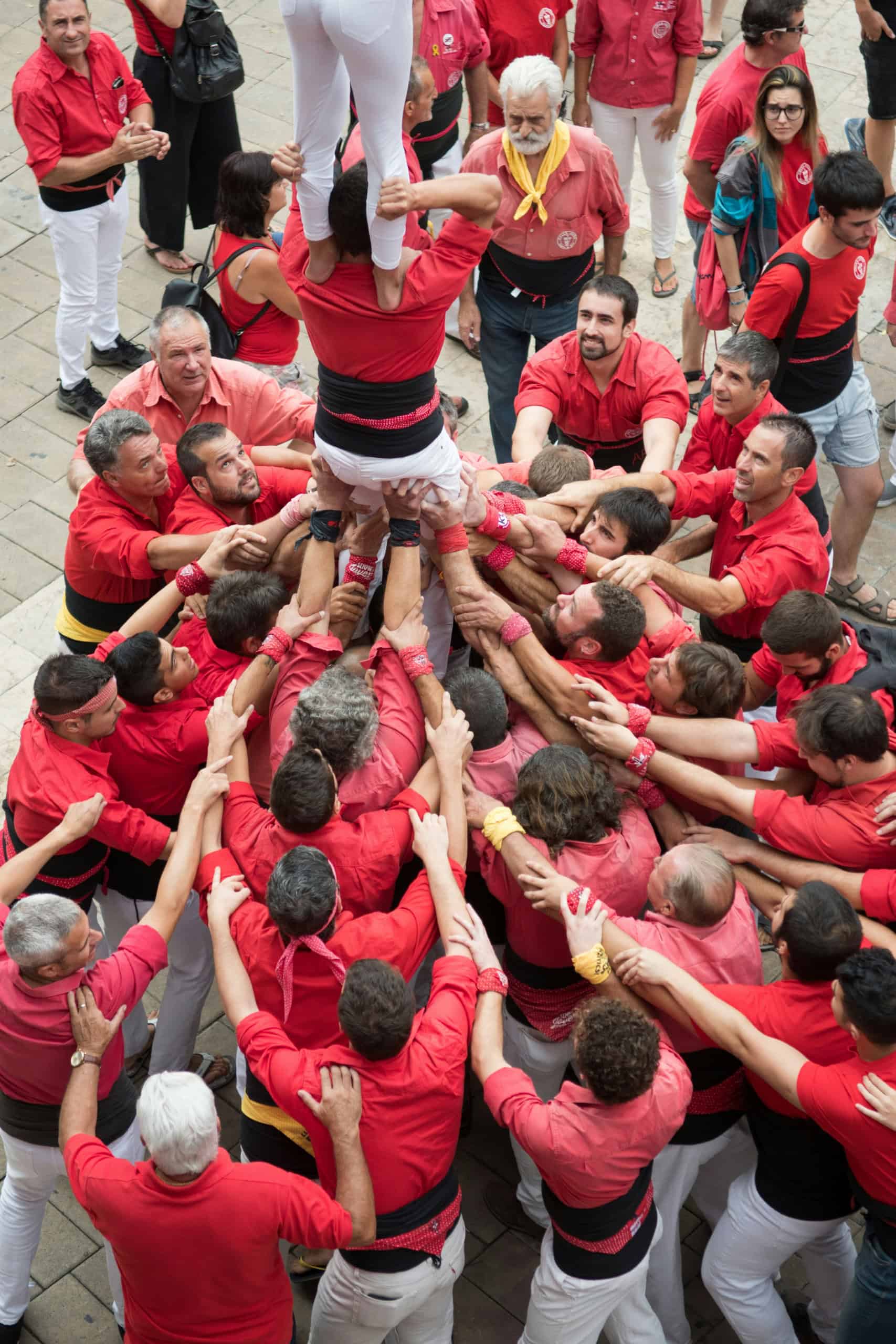
One of the reasons why working with families on intergenerational transitions is so complex (and so interesting!) is that there are many transitions, or transmissions, that need to take place.
They run kind of in parallel and sometimes in series, and they overlap in many ways too.
We’ll delve into this idea, inspired by a recent article that happened to focus on how artificial intelligence is affecting these challenges.
So, we’ll be looking at wealth, values, authority and identity and how families want to make sure that all of them trickle down the family tree.
✦
Section 01
Hat Tip to a Fellow FFI Fellow
The article in question is from the fantastic weekly FFI Practitioner (you don’t need to be an FFI member to subscribe, and it’s free) titled The Fifth Inheritance: Can Artificial Intelligence Transmit Judgment Across Generations?
Its author is Patricia Annino, an FFI Fellow and FFI Award winner, and it raises lots of great questions about how A.I. can be useful to families and those who serve them.
I want to focus my blog on what almost felt like a throw away line that grabbed me, because it matter-of-factly noted the four subjects that I don’t feel are recognized as well as they should be.
Here’s the line:
Historically, families have sought to transmit four things across generations: wealth, values, authority, and identity.
Followed by:
Artificial intelligence may introduce a fifth inheritance: judgment.
✦
Section 02
Lots of Focus on Wealth and Values
When I look at Annino’s list of four inheritances, it feels like they divide easily into a couple of pairs.
There’s always a great deal of attention (too much!) paid to the wealth, especially the financial component, so there’s no surprise that it sits atop her list.
Similarly with values, as soon as anyone points out that the financial wealth is not the only thing to consider, a large majority of those working in this space with families will quickly mention the importance of transitioning family values from one generation to the next.
And with wealth and values transitions getting so much attention, many families, and the experts supporting them, will think that list of two items is long enough already.

✦
Section 03
What About Authority and Identity?
We’re now getting into a couple of more difficult areas, and one where many families struggle.
The idea of transmitting authority in a family is naturally difficult in many cases simply due to math.
If authority is currently concentrated in one person or a couple (one household), what happens when the next generation is comprised of more people, in more than one household?
That’s what I mean by math, because we’re introducing the idea of division of authority.
Ideally the wealth will have benefitted from enough multiplication so that when it gets divided there’s still plenty for all. But are families also dividing the authority over that wealth?
It takes a lot of effort and intention to work all of that out, and it’s rarely easy.
Likewise with identity, attempting to maintain a singular identity over numerous households takes more work than most families are willing to undertake.
See The Special Sovereignty of G1.
✦
Section 04
To Transmit or To Transition?
One word that Annino used stood out to me and that was her choice of the word “transmit”.
I like that word better than “transfer” and I have written about my dislike for that word in the past. See Don’t Transfer Family Wealth, Transition It.
I just asked my friend Mr. Google something about transitioning identity, and some of what he came back with was way off the mark, believing I wanted information on a very different kind of transition that some families must deal with.
But coming from a family whose former business was fabricating towers used by electricity producers for their transmission lines, the idea of transmitting wealth, values, authority and identity will surely grow on me.

✦
Section 05
How to Transmit Judgment and Wisdom
The article was centered on how A.I. is being used to preserve the judgment of the wealth creator after they die, and it’s clear that there have never been more ways to do that than right now.
She uses the word judgment, and I like to equate that with wisdom.
The ability to consult a bot to learn what grandpa would have done is interesting but must rely on those asking to then come together and agree on how they’ll interpret that wisdom together.
Learning to have the judgment to use our forefathers’ judgment will be a difficult human task for many.
At A Glance
The Five Inheritances
Tap each card to reveal what’s being transmitted.
+Inheritance IWealth
“There’s always a great deal of attention (too much!) paid to the wealth, especially the financial component.”
+Inheritance IIValues
“The importance of transitioning family values from one generation to the next.”
+Inheritance IIIAuthority
“Transmitting authority in a family is naturally difficult in many cases simply due to math.”
+Inheritance IVIdentity
“Maintaining a singular identity over numerous households takes more work than most families are willing to undertake.”
+The Fifth — Inheritance VJudgment (or Wisdom)
“Artificial intelligence may introduce a fifth inheritance: judgment. She uses the word judgment, and I like to equate that with wisdom.”
The judgment to use our forefathers’ judgment.
Book a Free Introductory Call