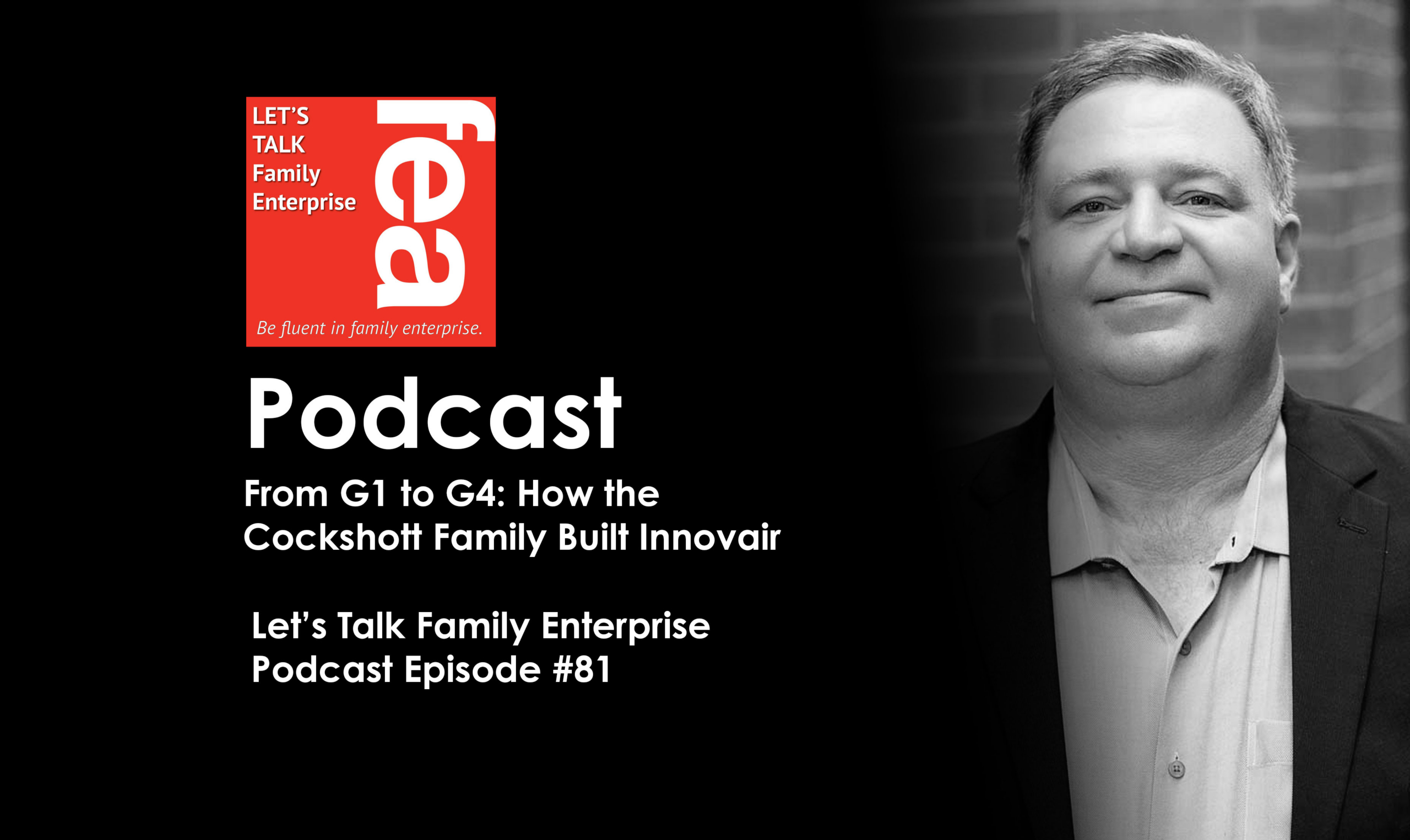
From G1 to G4: How the Cockshott Family Built Innovair
Let’s Talk Family Enterprise Podcast Episode #81
Host: Steve Legler
Guest: Grant and Owen Cockshott
Host Steve Legler speaks with father-son duo Grant and Owen Cockshott, President/CEO and Product & Marketing Manager of Innovair, a third-generation, Winnipeg-based supplier of industrial gases and equipment, and the most recent winner of FEC’s Family Enterprise of the Year Award.
Grant and Owen open up about accepting the award on stage together, and what the experience of Symposium looked like from a first-timer’s perspective versus someone who attended peer advisory groups decades earlier. The conversation traces the business’s evolution across four generations, from Grant’s entrepreneurial grandfather to his engineer father to the sibling partnership that shaped Grant’s own leadership style, and now to Owen’s arrival with a marketing background and fresh instincts for social media and e-commerce.
They speak candidly about working with family enterprise advisors on both governance and structure, the value and limits of requiring outside work experience before joining the business, and how Owen built a standalone e-commerce venture from a Harvard case study, turning it into a genuine business within a business. The episode closes with father and son each offering advice to the next generation stepping into family enterprise.
This episode offers a grounded, multigenerational perspective for family businesses navigating succession, new ideas, and the balance between honoring legacy and continuing to reinvent.
Here is a link to David Bentall’s book Dear Younger Me: Wisdom for Family Enterprise Successors.
Episode link to Steve Legler interviewing David Bentall about his book Dear Younger Me: Wisdom for Family Enterprise Successors. (available through Indigo and Amazon).
Transcript
Speaker 1 0:10
You’re listening to the Let’s Talk Family Enterprise podcast for everyone in the family enterprise community, families, advisors, and thought leaders sharing ideas that help enterprising families thrive across generations. Brought to you by Family Enterprise Canada.
Speaker 2 0:28
Hello, and welcome to another episode of the Let’s Talk Family Enterprise podcast. My name is Steve Legler, and it’s great being your host once again. This month we’ve got something special on tap, as I have not one guest but two, and rather than having an expert who works with enterprising families, we’ve got two people who work together in their own family business. And because it’s a family business, we’ll be speaking with a father-son team who are now running Innavare, a Winnipeg-based producer and supplier of industrial gasses, equipment, and services. Grant Cockshott is the third generation president and CEO, and his son Owen Cockshott is a product and marketing manager with the company, which was started in 1936 by Grant’s grandfather Wilf. Innovair also just happens to be the most recent winner of the Family Enterprise Canada Family Enterprise of the Year Award handed out in Vancouver at symposium in May. We’ve got lots to talk about, so let me welcome our guests, Grant Cockshott, Owen Cockshot. Welcome to the Let’s Talk Family Enterprise podcast.
Speaker 3 1:33
Oh, thanks, Keith. Yeah, great coming program.
Speaker 4 1:36
Yeah, thanks.
Speaker 2 1:37
So symposium. Let’s start there. Before it even started, the first awards night before the symposium started, you got to walk up on stage and receive this award as the Family Enterprise of the Year. Grant, how did that experience land for you?
Speaker 3 1:54
Yeah, it was exhilarating. I actually had a little bit of trepidation in the sense that my other son Ben, who’s four years younger than Owen, wasn’t with us, nor was my wife Ainsley, and we really see our family business as having a core nucleus of the four of us. But it just didn’t work out for other commitments they had. But it was really great. I mean, Owen and I, being on stage, I mean, it was pretty cool, wasn’t it, Owen?
Speaker 4 2:19
It was unexpected. You know, we didn’t think we were going to win, and so we actually we neglected to prepare speeches. But we got together in the hotel room before we went over to the award ceremony and said, “Okay, well, if we do win, what are we going to say? So we we you know we kind of we pulled it together, but it was an it was an amazing experience, and you know we were very honored by the FEC for winning the by winning the award, and yeah, I mean it was it was awesome.
Speaker 2 2:47
And Owen, I think this was your first time at symposium. So besides the award over the next few days, what did you take away from the experience?
Speaker 4 2:56
Yeah, symposium was, you know, I mean I I knew it was going to be good, but it it was really really good. It was a really eye-opening experience from the point of view of a you know sort of someone in a family business who is in the early stages of their career, you know, and still trying to sort of figure everything out, how businesses should be run, what kind of problems people face, and hearing from people who were, you know, in a similar stage in their career, other young people in family business about you know all of the problems that we share, and being able to talk to people who can relate to you-that was a really unique experience. Because honestly, I don’t know many people, you know, who are around my age, around the same point in their career, you know, locally, so it was it was awesome. Yeah, I really took away a great sense of community from FEC, as well as perhaps a I’ll call it a better sense of you know how everybody in family business really encounters some very similar problems.
Speaker 2 4:02
You’re speaking to an issue that I often, when I when I talk to people who are at their first symposium and what are they enjoying about it, it’s often exactly that. Oh my God! I finally have other people I can talk to who are going through the same kinds of things that I am. But you’re pointing out also that the age finding people around your same age and stage is also one of the benefits of attending.
Speaker 4 4:26
Absolutely.
Speaker 2 4:27
Okay. Now, Grant, families attend this together, but sometimes there are different sessions available. Did you guys go to the same sessions, or did you have a strategy, or you did you bunker and and take notes on different sessions you went to, or how did you experience it?
Speaker 3 4:44
Well, we did to a certain degree. I mean, after a while, there were just certain symposium sessions that I really wanted to go to. In fact, you know, I had been to a symposium before. I think a couple of times back in the ’90s, early ’90s, when I was involved in a first a peer advisory group. So I had a vague idea of what it was back in those days. It’s completely different. It’s far more structured and organized. At the same time, it’s also kind of impromptu and and real. So there’s a great balance between academic sessions that really have legitimate experts speaking to certain topics, and the problem is you can’t you can’t you can only go to one you can’t go to two at a
Speaker 5 5:25
time.
Speaker 3 5:26
So I found that to be kind of it was a good problem, but yeah, Owen and I basically I think we just some things we just wanted to take in together, and we would sit at each other and sort of commiserate. No, I mean it was I’m going. We both agreed one thing for sure is we’re going to go again next year, which I think is in Toronto. So yeah, we’re going to go back again.
Speaker 2 5:46
Okay. So Grant, you mentioned that that you had gone before and you were part of a PAG. I understand. I think your dad was one of the key people in in cafe at the time of of starting it in in Winnipeg. Is that part of your lived history with this group.
Speaker 3 6:02
It’s true. Yeah, my father and my mother in Manitoba. Well, in Winnipeg, we had a chapter of the Canadian Association of Family Enterprise, and my parents, along with I think six or seven other family leaders, got together and helped launch the chapter. A few years later, let’s see now, 1992. I joined the business, and one of the first things I did is I joined a peer advisory group. And my brother, who’s 10 years older than me, he was in another one. And back then, heyday of cafe, there was in our chapter alone we had six or seven Phgs, and I tell you that was a really formative experience, and it really helped my brother and I work out our differences. And I had the next 15 years of my working life were with him, and it was a great experience. And to this day, you know, I share. Even though I bought him out years ago, I I share anything he asks me, and you know, he really trained me to run the business, and I attribute that to learning practicality and emotional maturity through participating in a in a PAG. It was really important experience for me, and I I really wanted Owen to have the same experience. So our hub Winnipeg is really just getting off the ground, and he’s in a you’re in a PAG, Owen, right?
Speaker 4 7:20
Yeah, I’m in a PhD. Yeah, there’s there’s not many left in Winnipeg, but you know, like Grant said, we’re we’re getting it going again. So well, a lot of
Speaker 2 7:28
things are restarting again in this new version of FEC that is that is moving forward with hubs. We have a hub in Montreal. My dad was a member of Cafe back in the ’80s, and so I have a little bit of that lived experience of how this organization can support families, and how it is evolving to continue to do that in more and better ways going forward. But one of the differences back from the ’90s, if you went to symposium then, is that now FEC is the home for families, but also for all the FEA advisors, and so it makes for a different kind of atmosphere where you have a few 100 people in the room, and about half of them are families, and half of them are from advisors. And I also understand from your acceptance speech when you won the award that you have worked with some, a couple of FEAs over the years, and I was hoping you could speak to what that was like and what it’s like being at symposium with a bunch of advisors in the room as well.
Speaker 3 8:29
Yeah, Owen, do you want to talk about our experience with Chris Reichert, and I can talk about our experience with Tannis Dawson.
Speaker 4 8:36
Yeah, absolutely. Yeah, so we started working with Chris about a decade ago now, and that has been a great experience for us. I I was not aware a decade ago. I was 19, so you know I was just coming out of high school, and I had not heard of the concept of family advisors prior to meeting Chris. You know, so I didn’t really have many expectations, or I wasn’t sure what to expect. But it was it was a great experience working with Chris. We started just kind of by having an open conversation about who we are, what we enjoy. We found out that we had a shared interest in cars, which was a great help to kind of break the ice. But really, the benefit of working with someone like Chris is that you have someone who’s essentially an expert in the area of family business, whether it’s succession or you know conflict management or like long-term planning, and you get to leverage their experience, but you also get a fairly, I would say, non-biased opinion, which is critical, I think, on you know the the challenges you might be experiencing as an individual or as a family or as a business, and you know really I I could not recommend more working with Chris or someone like Chris if you’re listening and you’re not working with a family advisor or you’re on the fence. It really really has I think laid a a great a foundation for us to to move into the future as a family and as a as a business, yeah. But Grant, I guess I’ll pass it to you.
Speaker 3 10:06
Well, yeah, and and just from my perspective, I’m working with Chris, who, by the way, his area of specialty is in government. So his background is helping build family councils, governance structures, conflict resolution. At times, you know, he’s been he’s worked with families where family members haven’t spoken to each other in years, and so he has, as as many people do who specialize in governance, a knack for being able to find to help people find common ground. In our case, you know, our younger son Ben was only 14 at the time, or 15, I guess, and and Ben was or Owen was around 19, and if I speak for my wife on this topic, what we really enjoyed is learning how we’re similar as four family members, but also how we’re different, and then learning the skill to respect that difference and to listen with intent, and so he literally trains us to understand what are our personality traits. Even though we’re among the same family, we think we know each other. When you actually do some of these personality assessments, and then you learn the skill of listening and communicating, it’s really foundational. And starting at 15 was not too early. I mean, I remember, you know, playing a board game about managing money. I remember going on hikes and walks, you know, and then and just chatting. And we always take a turn when we get together, which is twice a year, sharing what we’re interested in and what we’re up to and what our passion is. And I, for my part, get to talk about the family business, because that’s that’s my full time occupation. Now that Owen’s involved full time, he similarly has his turn at the table to talk about things. My wife is a very active volunteer, and so she gets to share her passions. And my son Ben is pursuing a career in the Navy Reserves, and he’s starting school soon to become a paramedic. His goal in life is to become a search and rescue technician in the Royal Canadian Air Force. So you know it’s really cool to be able to have this platform that we’ve used and leveraged over these 10 or 11 years now. But I wanted to just take a second to talk about another aspect of working with an FEA, and that is not governance, but structure. And so, structure is kind of an expression that I’ve learned that relates to building that financial and legal framework in which a family can succeed through multiple generations. And so, we we ended up working with a woman from TD Wealth, Tannis Dawson, also an FEA, and we partnered with, of course, another person who’s our lawyer, who’s not an FEA, Steve Cohn. And with the two of them, we were able to build a structure for our business that was both of financial and legal nature. And I have to tell you, like you know, I came to appreciate that as important as all that is, that’s plumbing. It’s plumbing and electrical. If you were to use an analogy in construction, governance is much more challenging. It’s it’s below the waterline. It’s the stuff that goes unsaid, and I tell you, it’s like as if you have two arms, and if you only paid attention to the plumbing and electrical, and you got muscles in one arm, and you didn’t use the governance arm, you’d be like a you know a weird crab or something. You just wouldn’t be balanced.
Speaker 2 13:33
Right. So there are FEAs that specialize in different areas, and and one of the things, having gone through the FEA program, is the emphasis on multidisciplinary collaboration and making sure that the experts who are specialized on one side actually know how to talk to the experts on the other side? Because every family needs support on all these areas, and too often the families are getting support from one, and then later they’ll get support on another, but they don’t talk to each other. So it’s it’s important that all these experts that are supporting the family understand each other. I want to pivot over to the similarities or differences as your business has gone from g1 to g2, and then g2 to g3, and now what you’re looking ahead to g3 to g4 someday down the road. But you already hinted, Grant, on the fact that you actually are like a g2 and a half, or or g3 and a half, because you you worked you took it after your brother. How did how did that? Can you start with the first one from your, I guess, your grandfather to your dad?
Speaker 3 14:45
Sure. Yeah. Well, and so I just want to make a minor correction. My grandfather started our business. He incorporated it in 1946. But you are correct. He did start it in 1936. But it was kind of like an activity on the side of his original main business, which was a radiator repair business, he started in the 1920s. So my grandfather was truly, you know, an entrepreneur.
Speaker 2 15:08
Right,
Speaker 3 15:09
he was an expert at finding an opportunity and making opportunity out of it. And we have some old pictures of of my grandfather in the office. I hardly knew him. He passed away when I was 10 years old, but you know he was an entrepreneur, and and one of the things I’ve come to appreciate in my father, who took over the business in 1956, and you know he’s a chemical engineer, and he came back from McGill, where he studied engineering, came back to Winnipeg and took over the business, and brought brought his his wife, my mother, with him, and so my father was a combination of a an administrator and a custodian, but also an intrapreneur. You know, my father really understood opportunity as well, and my brother, who started in the business about let’s see now, probably three years before I joined, maybe it was four. My brother was similar to my dad in personality. They’re very, very alike. I was very similar to my mother, so much more interested in HR, marketing, that kind of stuff. I was more of a kind of a interested in people, and so I gravitated to that. My brother was much more into accounting, administration, process. so one of the things that helped us in our in our time together, our 15 years together, is we we had different areas of expertise, and we tended to sort of figure out how not to tread on each other’s toes, and that was a big feature. But when I think about what your question is pointedly about, you know, being the third generation is what I’ve come to understand. Is it’s really important to always be reinventing the business. You know that’s how we’ve made it to 80 years, and in fact, about 10 or 12 years ago, I changed the name of our company. It used to be a very literal name about what we sold. So we were called Welder Supplies Limited for the first I don’t know 68 or 70 years, and I changed our name to Innovar because I wanted to conjugate what we were good at, which is innovation and bringing innovation to our customers, and the main thing that we sell, which are products made from air. So anyway, I really love the idea that Owen comes into the business with a background in marketing similar to me, but also that new generation’s perspective on on strategy and the evolution of social media and the influences that are driving decision making today in AI, for example. So you know businesses need to constantly be reinventing themselves, and if you’re not an innovation or an entrepreneurial intrapreneurial company, I think you’re really going to find yourself on a bit of a clock ticking down, and we don’t want to be that kind of company.
Speaker 2 17:52
And so you’ve brought in your your son, who’s 29, and he had work experience elsewhere. Was that? I know some family businesses have a rule that you have to work outside before you come in. Did you have a rule like that, or did it just work out that way that he was working elsewhere and now is in the business?
Speaker 3 18:11
Yeah, I would say it’s like it’s not a hard rule. It’s an informal ideal rule. I worked outside the business for about three and a half years. My brother did as well. He worked in Calgary. I worked in Toronto, and I got transferred to Edmonton. My father, when he got out of engineering in Montreal, he stayed in Montreal, worked for a railway company and a flooring manufacturer before he moved back to Winnipeg. I do think it’s a good practice, really, to work inside the business. But you know, Owen, what’s your what’s your reflection on that?
Speaker 4 18:47
Yeah, I mean, I would say that I gained a lot of experience working in a business where you’re not like related to the owner in some way. You know, and it’s different, isn’t it? Yeah, it’s a very different experience, and I would encourage anybody who is, you know, who has maybe children and you know are interested in having them be in the family business that they seek outside experience at some point. I think that it’s important to get those sort of experiences in companies where maybe the culture isn’t that great, or maybe it’s really good, and you want to emulate that when you get back to the business. You gain so much from being in a working environment where, you know, things are very different, and you know whether that be another family business or maybe it’s a large corporation. In my case, I worked for DHL Supply Chain as a warehouse supervisor. That was something very different from anything I’d ever done before, and I learned a lot. And I think that it was an important experience for me. And honestly, I would say that I wish I spent more time outside the business. And that’s not because I don’t enjoy being in the business. I enjoy it a lot, but I wish I had more of those experiences outside of the business before I came back. I think I would have felt a little bit more grounded, maybe a little bit more comfortable, if I had had a little bit more experience on the outside. Now, that’s not to say that I I didn’t pick up lots of knowledge and experience working the last you know six and a half years or so within our business. I think that it’s totally possible to, you know, successfully integrate yourself into a family business with maybe less experience outside, but I do think it’s important.
Speaker 2 20:31
So I’m glad you’re speaking to that because this is a common question that a lot of people have: like, should we force them, and do we have this rule? And there’s not one answer to it because it really it really depends. And you mentioned something that I don’t often hear people say about the outside experience. You were hinting at there’s some good stuff that you can learn that you can bring to your business, but there’s also some bad stuff or some culture that you don’t want because you’ve experienced it. So so that also helps you to then mold your family business differently in terms of culture. Was that what you were hinting at?
Speaker 4 21:07
Yeah, absolutely. I think that you know when you work outside the business, you are exposed to different ways of doing things, and in my case, you know, working in supply chain at a large company like DHL, very corporate environment, very process based, lots of work with lean improvement and things like that. But the culture is just different. It’s it’s a large corporation. You feel like more of a number than you do at at a family business, and I think it was good for me to experience that because it it helped contrast those two very different styles of workplace, and you know it wasn’t necessarily bad. It just was different, and in my case, I went from supply chain into more of a marketing and e-commerce focused role here at our business. But certainly, there were things that I was able to take from my experience outside and bring into my career here. So I, yeah, I think that there’s both good and bad experiences that both can have a beneficial impact on your transition into family business.
Speaker 2 22:13
I wonder if your experience outside for a few years helped you internally as you arrived with the same last name as as the owner, are you perceived differently, having come with some experience from elsewhere?
Speaker 4 22:29
I think you probably would be. Like like you said, it’s there’s no right answer. I don’t think that it’s essential to if you are coming into a family business and you haven’t worked, you know, outside, and you know the the people that you’re working with at the family business maybe think less of you for that reason. I don’t think that that’s necessarily true. I think that when you come into a family business, like no matter how much experience you had outside or or or or not, you know you are still building your reputation and you’re still you know you know proving yourself to some extent, but also just getting familiar, like familiarizing, familiarizing. Sorry, yourself with you know your coworkers within the within your family business. So, I think that you know there’s there’s still work that that needs to be done on that front, no matter whether you worked at I don’t know Goldman Sachs before you came or not. So,
Speaker 2 23:18
so yeah, how you conduct yourself when you arrive is is probably more important than anything else. So, Grant, now you have this young man come in, and you were talking about, you know, having new ideas. How is that going when he comes with new ideas? Are are is he always are they always welcomed with open arms, or how how are they debated, and how do you guys go through making decisions together with with all your experience and with some of his new ideas.
Speaker 3 23:47
Well, that’s a great question, and I think I had mentioned earlier how you need to become an entrepreneurial organization to succeed in the long term. The way that you become that way is you is you feed off of the the new ideas that that come through the lived experience of a younger person, you know, and how they relate to technology and social standards and ways of communicating and and how consumers behave. You know, our business is kind of unique because around a third of it, maybe even a little bit more than a third, is business to consumer. You know, that’s our healthcare business in particular. Our industrial business is almost exclusively business to business. So, when you’re a person that’s coming into this business in the role that Owen’s in, which like Owen, you know he’s I think being a little modest here, but he literally launched our e-commerce practice in our healthcare business, and started an online e-commerce sleep apnea distribution business called Remology.ca, and he built that through all I gave him was a case from Harvard Business School about social marketing, and then he ran with that, and I thought that was a really cool thing because I’m a fan of Harvard Business School and the case study method, and he really took that and built a team, and then launched this website that is kind of like a learning environment for people to engage in the issues around obstructive sleep apnea, which we treat people for using CPAP therapy. That’s that’s our our main gas manitola business unit, and so I remember the next year I returned to Harvard, and this professor who taught that case was teaching another class, and I was given the the honor of introducing her to our our class, and I related the story about how I took this case called Glossier. It’s actually about makeup and and cosmetics, and I shared the story about how from that case my son launched a business within a business, and you should have seen the expression on the professor’s face. You know, it was just the most fulfilled kind of look on her face, and I think that’s a beautiful thing, and it’s a it’s a great example of how a young person can take a young concept, which is you know this whole idea of of influencer marketing, and turn that into a business. and And it’s operating to this day. It’s financially successful. I mean, I don’t know how you feel about it, Owen, but I think as the years go by, you’ll look back on that. I hope fondly and the experience of launching a business.
Speaker 4 26:20
Yeah, I mean certainly, I think certainly I look back on the experience fondly. I, you know, it was a it was a daunting experience in it, because you know you are. I came again from DHL, an environment that’s very structured, very process based. Everything is laid out in front of you. You know, there’s there’s a there’s a right way to do everything, and when you get into a situation where you’re you’re in a family business, you know maybe this is your sort of first role here. You feel like you need to prove yourself, you know. You feel like you have eyes watching you, looking at every sort of mistake that you might make, or that can be a daunting feeling. I think that’s common for all young people entering family business. So you know what I would say is, and you know I’m not saying that I’m some sort of expert, but I have you know lived the last six years, six and a half years in the family business, trying to do just that, prove myself to the people that I work with. And my advice in in that capacity would be to just keep going. It really sounds corny, but it’s it’s true. I mean, it really is just a matter of you know going forwards at all times. And I like this thought that is basically that things don’t have to happen in sequence all the time. Oftentimes you’re building momentum over a period of time, and then it sort of breaks loose like a dam bursting. And that’s how I’ve really found development in my own career: is that you know you you feel like you might have moments of plateauing that extend for you know whatever, a year maybe six months, and then there’s there’s sort of a breakthrough moment that you have, and and and that’s really something that I think I took from this experience of building this e-commerce site, and because there really is there’s no like I didn’t know how to do this, nobody else at the company knew how to do it, we’d never had a marketing department before. We did have an e-commerce site set up previously for, but you know it was, it was something that we we needed to sort of redo, and so you know this was a big learning experience for everybody involved, and I would say that working in a non-structured way is something that I really benefited from.
Speaker 2 28:18
So it was liberating for you, and so it was great to have the freedom to do that, which you wouldn’t have had probably in in another business. Totally, Grant and Owen, this has been fascinating, and unfortunately, we need to start to wrap up soon. So I’ve got a couple of requests before we go. Grant, if you could offer one piece of advice to a parent who’s about to welcome one of their children into the family business that they’re running. What would
Speaker 3 28:45
it be? Well, I love that question. What I would suggest is do yourself a favor and go online and buy a copy of David Bentall’s book called “Dear Younger Me. Dear Younger Me is an easy read. It’s nine things that he has reflected on that are really important to a young person’s success in a family business working environment, and you know just a couple of them, just so you understand what some of the they are. It’s being curious, it’s developing emotional maturity, and and it’s being respectful. And you know if you can if you can get your way through understanding how you need to build your muscles in these nine areas, given the examples that that David outlines in his book, you’ll do your your your child a huge favor and yourself.
Speaker 2 29:34
Thank you, Grant. And I interviewed David Bentall about his book back in 2021, I was trying to just Google the answer, and we’ll put it in the show notes so that people could go and click on that one next. So thanks for that, Brett. How about you, Owen? If you could offer one piece of advice to a person around your age who’s about to join their family’s business, yeah,
Speaker 4 29:58
you know, it sounds kind of boilerplate, but what I would say is keep trying, do your best, don’t stop, see everything as a learning experience, even the mistakes because you’ll make them. I certainly have, and you know, take it day by day, and you know, just be respectful, be open-minded, listen lots, and give your opinion freely when you feel like it’s required, because you know the years go by, and as you stay there and spend more time, you’ll become more comfortable and more familiar with how things should be, and you’ll develop your own opinions on the future, and that’s a really fulfilling feeling. So there’s really nowhere else I’d rather be, and I hope that other people get to experience working with your dad or your mom, you know, being part of a legacy. So it’s it’s a it’s a great thing.
Speaker 2 30:48
Fantastic! The time flew by quickly as it always does. Owen Grant, thanks for again for joining us and sharing your experience with us.
Speaker 4 30:58
Of course,
Speaker 3 30:58
thank you,
Speaker 2 30:59
listeners. If you have not already subscribed, please do so. Make sure to never miss any of these monthly episodes. Thanks again for joining us. I’m Steve Legler. Until next time. If
Speaker 1 31:12
you enjoyed today’s episode, you can subscribe to us on Spotify, Apple Podcasts, or any other podcast app. And don’t forget to share this episode with family, friends, and colleagues.
Transcribed by https://otter.ai