
No Money bag sign icon. Dollar USD currency symbol. Red prohibition sign. Stop symbol. Vector


In some ways, this blog has been a long time coming. It feels like an obvious topic for me, I am almost surprised at myself for not having addressed it yet.

I am not sure what triggered it now, but here goes, let’s see if I can turn this question into something useful and entertaining.

Money has a huge impact on all of us, and working with business families and those in the UHNW space (Ultra High Net Worth) it is obviously top of mind much of the time. But for people who have a lot of money, is money all that they talk about, think about, and worry about?


What else is there to talk about?

In my experience, those who have plenty of money prefer to talk about other subjects. Maybe it is because they don’t have to worry about where their proverbial next meal is going to come from, or maybe it is because they are tired of listening to all the financial experts in their lives, who seem to talk about little else.

I arrived at this calling of working with enterprising families after a couple of decades managing a small family office that was created after a liquidity event in my family when I was in my twenties.

I quickly learned that when you are managing your family’s wealth, it is much better to lay low, or else you will become a target for anyone and everyone peddling their wonderful solutions to problems you never knew you had.

I guess one of the reasons I am writing about this now is that I have noticed an uptick in the number of these financial solution peddlers hitting me up lately. You see, when I decided to enter the world of family advising, it made much less sense for me to lay low, and in fact I needed to do a 180 and try to make a splash.

The curious thing is that these peddlers are contacting me repeatedly now, and I find very little compelling in what the vast majority is offering. For everyone who claims to offer something unique, I could literally find five to ten others offering something quite similar within a few block radius in any major city.

Before I look at how you plan to take care of any money that I might allocate to you, I need to feel comfortable with you and learn one whole heckuva lot more about you, and your firm, AND know that you have taken at least a bit of time trying to understand ME and my family.


Do I need ANOTHER financial solution provider?

Most families don’t need another financial solutions provider. They are almost literally available on every street corner.

Families who own significant wealth will more likely need help figuring out how to treat all family members fairly, whether they grew their assets by 5% last year or by 10%.

They will more likely appreciate help in deciding how to think about, plan, and communicate their legacy decisions, as they imagine how the things that they have worked for all of their lives will play out as the wealth gets transitioned to the next generation.

Oh, and that NextGen group? Yeah, well they probably have lots of questions for their parents too, not they they feel comfortable asking them. What kind of questions?

You know, the ones about fairness, controlling their own destiny, having a clear understanding of all of the “dreams and plans” that their parents have for them and their wealth, but that have not been discussed or written down anywhere.

If bragging about how your fund beat the S&P by 2 percent last year is what you wanna sell, good luck with that.


That Pie is pretty big!

Once the family pie reaches a certain size, making it bigger ceases to be the focus. Figuring out how to enjoy it as a family together over generations takes over as a priority.

Families have a pretty good idea of what they want to do, and why they want to do it. They usually need help with the HOW. The how involves family dynamics, and that can be a scary subject.

Can you help a family with that? If not, you better find someone who can.


1yWhat are you leaving your Family - Curling Game

Just about every parent gets to a point in their life where they cannot help but think about just what they will be leaving their children when they die.

Among the things that they think about are both the tangible, like money, property and other valuables, and the intangible, like life lessons, values, unforgettable life experiences and a true sense of their family legacy.

“What” is not the only question that comes up of course, there is also “why” and “how”. And let’s not forget the sub-parts of “what”, like “when”, “where”, and “who”, but they’re well beyond the scope of one blog post.

The “why” and the “how” are pretty important to work out, because they are so often the root cause of family conflict afterwards, when children are unclear as to why their parents arranged things as they did.

When I ask these questions of parents, the “what” is the easiest place to start, and I always begin with the tangible stuff. We are not ignoring the important intangible things, just delaying them until we get a better handle on stuff that everyone can see and agree on.

I’ve always been a sports fan, and maybe even a bigger fan of analogies, and plenty of sports analogies come to mind on the topic of “what you are leaving”.

In rugby, when a team scores a “try” (similar to a touchdown in football), they get to kick a convert for more points, but unlike in football, the spot of the kick depends on where the player downed the ball in the end zone.

So if a player scores a try near the sideline, he (or his teammate) needs to attempt a much more difficult convert than if he scored in the middle of the end zone.

Moral: The details of what you leave definitely affect others and their likelihood of success.

In hockey, the difference between a good goaltender and a great one is often their ability to control rebounds. A good goalie stops the puck, a great goalie will not only stop the puck, but also make sure that it ends up in a location that makes it more difficult for the opposition to score on the rebound.

Moral: It is important to think not only about what you leave your loved ones, but also what you do NOT leave to others.

In billiards, a good player will sink the ball in the pocket, and then see what the next shot will be. A great player will plan her shot so that she leaves the cue ball in a good spot for her next shot, or at least not in a great spot for her opponent should she miss.

Moral: Sometimes you need to decide what to leave, without knowing what comes next.

In curling, you always know that your opponent will be throwing the next stone, and once again there is a huge difference between good players and great ones. Also, curling is the ultimate team sport.

A good team will make their shots and hope for the best with what happens next. A great team will always consider a number of things before even choosing which shot to attempt:

  • What is the score?
  • What are we trying to do with this rock?
  • What will the other team likely try with their next shot?
  • Where do we ideally want all of the rocks to be when they all come to a rest?
  • What happens if we miss, and how can we miss in a way that still gives us an OK result?
  • What are we planning to try on our next shot?

Moral: Complex decisions always entail a number of questions, and the best decisions come when the members of the team know each others’ abilities, trust each other, and have a clear idea of what they are trying to do together.

The curling analogy fits best for me, as each player contributes to each shot, and a great team needs to have great players and be well coached.

Your kids are part of your team, aren’t they?

Who is coaching your family?


Hand with marker. Blank TO DO LIST list business concept, chart, diagram, presentation background

Most people are familiar with the concept of a “To Do” list, but there are so many different ways that they are used, and their relative importance in various people’s lives got me thinking. And of course when something gets me thinking, a blog post invariably soon follows.

Along the way, I am going to touch on the “will do” question, the “must do”, as well as the “could do”. As usual, there won’t be much “telling you what to do” from my end, because the older I get the more I am convinced that telling people what to do is one of the worst ways to get them to do what you want them to do.

The “will do” question doesn’t necessarily fit with this topic, but I could not help but include a quick discussion on it. It comes from the world of HR and hiring practices, and I have seen it a couple of times recently.

When you are looking to bring someone into your organisation, you will undoubtedly look at their qualifications to see what they “can do”, because you prefer not to hire someone who cannot do the job. But more and more, HR people are also being asked to look into what candidates actually “will do”.

I’m not sure if this is a “millennial” thing, but having people decide that some tasks are beneath them is becoming an issue that more and more companies are dealing with.

Moving along to more conventional “to do” list questions, I have found that it can be quite helpful to separate things out into a “must do list”, with a timeframe, and then everything else.

Some people rank their items A, B, and C, and start with the A’s until they are done, and then move on to the B’s. Some people plan things out for the week, others on a day-to-day basis. Whatever works for you is better than nothing, but coming up with a system that becomes routine has been a key for me.

I plan things out on Sunday as I look at the upcoming workweek, slotting in important tasks among whatever scheduled events I have booked.

If you are also trying to incorporate some physical workout goals (4 times a week has been good for me) this can be useful too, in the mode of “making an appointment with yourself”.

The items that are less urgent and don’t need to be done this week still need to be housed somewhere, because you need to keep longterm ideas, projects, and goals in focus. I use a whiteboard in my office, where I keep monthly and quarterly items in view at all times.

After looking at an important item for a while, I will often begin to feel some guilt about not having started it yet, and that will usually get me to break it down into more bite-sized pieces, the first of which will then go on to my following week’s “must do” list.

But my favourite aspect of this “_____ do list” question is the one I call the “could do”list.

To me, life is all about possibilities, and I find it liberating to have a number of big ideas laid out as things that I could do, both personally and for and with my family. I even like to think this way about client families that I am working with.

Whenever I am in a leadership position with a group like this, my preferred modus operandi is to share a variety of possibilities with members of the group, and then lead a discussion where the group selects what they think is best as far as next steps.

Of course there are some choices that I might logically prefer over others, but when harmony is important, whether it be in my own family or in a client family, this method works much better that the old style authoritarian way.

This is not exactly leading from behind, a concept that some people love and others despise, but more akin to leading from within.

Now, you don’t have to do this, but you could!

Foreign language study concept background - stack of dictionaries isolated on white background

Having grown up in Montreal, a bilingual city, has been a wonderful boon to me. But the daily exposure I have had to both French and English has some benefits that many local friends take for granted.

Starting first grade, my Dad had decided to send me to French school, for my own good, but mostly because he wanted me to be well prepared to take the reins of the business that he was building.

In my 20’s, I took a vacation to Mexico and felt really ignorant because I did not understand the language, so when I got back, I headed to the YMCA for Spanish courses.

Facility with language learning is not something everyone has to the same degree, but having exposure early in life certainly helps one have the confidence needed to learn a new language when needed.

So what does this have to do with family legacy, you ask? Let the analogies begin.

Dealing with your family legacy requires getting used to some new language, or at least some new vocabulary and new ways of expressing yourself, to develop common understanding.

Just like learning a new language, you don’t just decide to learn Spanish one day and become fluent the next.

These days there are new methods like Rosetta Stone that take advantage of technology and a better understanding of how people learn languages best, but let’s just break it down into some simple levels.

For many, reading a new language is the easiest way to begin to understand, because you can take your time and look at each word. Hearing people speak the words and understanding them in real time is more difficult.

To speak and be understood is again another level, and writing something coherent in an unfamiliar language is not advisable until you are much further along.

My point is that there is a progression through different levels, a need to move up gradually to develop a vocabulary, a comfort level, and the confidence to speak and use the new language.

In a family trying to preserve its legacy, to transition from one generation to the next, many important questions arise, like:

  • Who does the work
  • Who undertakes the leadership
  • Who keeps things on track

When families fall apart, it is almost always because somehow things fell through the cracks or people did not get along and agree. Often, nobody really ever understood and bought into the plans in the first place.

For the members of the rising generation to buy in, there are some things that are almost indispensable to have in place, to one degree or another.

The siblings (or cousins) need to share at least some level of financial fluency. Like a language, nobody just decides to learn it and gets there really quickly. But if a group of people is expected to work together on a big project, it helps if they all have a basic level of understanding of the subject being discussed.

But if basic financial fluency was all that was required, that could be remedied easily enough, assuming a willingness to learn.

The harder part is learning how to work together. The family interaction part is where so many plans go off track. Once again, a phased leaning process can help.

Let’s look at what makes people progress faster when learning a new language:

  • A teacher who knows the language AND how to teach it
  • Lots of opportunities to practice
  • The ability to give and accept feedback
  • A helpful, “can do” attitude of those learning together
  • A safe environment so nobody is afraid to make a mistake

Preserving a family legacy for future generations is no easy task, but if the people you are counting on to make sure it happens all speak the same language, it sure helps. If they helped each other learn it together, even better.

People can learn to work together, but first they must all be aware of just why it is so important for them to do so. Some basic family harmony is required, and unfortunately, it doesn’t usually happen all by itself.

Comprenez-vous?


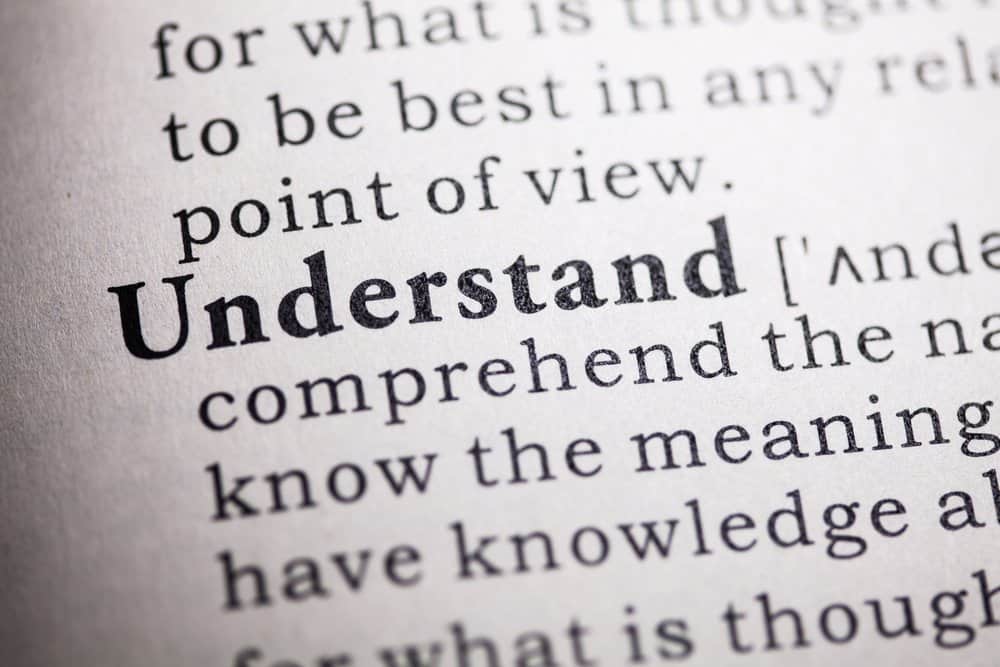
Fake Dictionary, Dictionary definition of the word understand.

The year 1989 was an important one for me, as it was the year that I quit smoking, and more importantly also the year that I first met my wife. If you ask her, had I not quit smoking, I would not be her husband today.

But 1989 was also the year that one of the most important books of the last 50 years came out, and I am sure that most of you will recognize it, and many of you will have read it as well.

I not only read The 7 Habits of Highly Effective People, but a few of those habits have become cornerstones of how I have tried to live my life ever since. I hope that this will not lead to an analysis of just how effective I have been, but I do want to share with you my favourite habit of the seven.

Now there are a couple of the habits that are more easily recalled than my favourite, because they have become part of our vocabulary, partly thanks to the success of the book, which sold over 25 million copies.

“Think Win-Win” and “Be Proactive” have become sayings that most people will have heard before, and “Put First Things First”, and “Synergize” are also kind of cool, but still not number one on my list.

Is it “Sharpen the Saw”, or “Begin with the End in Mind”? No, but I like those too. My favourite is habit number 5, “Seek First to Understand, and Then to Be Understood”.

I like to abbreviate things, so I will just call it Seek First to Understand, or SFTU. The first time that I jotted it down using just those four letters, I was struck by how closely it resembles another 4-letter acronym, STFU. For the uninitiated, STFU is short for “Shut the Hell Up”, or something close to that.

The reason that I found this so relevant is that STFU is actually almost the exact opposite of SFTU, especially in the arena of family business and family leadership.

The old fashioned, autocratic parenting style that many of us boomers lived through was very much “this is how things are going to be”, and if anyone dared to question Dad, we were often told, essentially, to STFU, and get in line.

Nowadays, thanks in some small part to the popularity of Covey’s book but also in large part to societal changes, people have mellowed somewhat, and active listening is actually something that many leaders are taught to do.

But Seek First to Understand is not just about listening, of course. Yes, you often need to listen, and watch and read, and interpret, but the goal here is understanding.

And please note that the habit is not called “Seek to Understand”, but Seek FIRST to understand.

That little nuance is the key, because that is where the leader needs to have the maturity to admit that they do not necessarily have all of the answers, that they have the curiosity to learn about the ideas and opinions of others, and have the courage to ask and listen to what others have to say.

Those who advise families in business who are hoping to transition their business, their wealth, and ultimately their legacy to the next generation will almost all agree that clear, frequent and open communication is an absolute necessity if you want to have any chance of success in this endeavour.

Obviously, I agree. The point of this blog is to remind people that good communication is predicated on the people communicating having the right attitude so that a true exchange of ideas can be had.

I love the old quote attributed to George Bernard Shaw, “The biggest problem with communication is the illusion that it occurred”. People assume that because they said something, the other person heard and understood them. They often go even one step further and assume that the person agreed!

Please try to Seek First to Understand, and Then to Be Understood. It will be well worth it. It is a habit, so that means that it can be learned.

And it sure beats the hell out of STFU!


Writing Last Will and Testament. Closeup shot

A few weeks ago I came across a blog post by the Blunt Bean Counter on Ethical Wills that I liked, and I encourage anyone interested in this subject to check it out. Perhaps I can whet your appetite with my take on the subject here.

The man behind the blog and the website is Mark Goodfield, who is an accountant from Toronto. I would not necessarily call him an old friend of mine, but we did meet professionally last summer at a BDO SuccessCare course, “The Role of the Most Trusted Advisor”.

We spoke about blogging one day at lunch, and it was thanks to some of his comments that I undertook a rebranding and reworking of my online presence, for which the feedback I have been receiving from some of you has been gratifying.

An ethical will is essentially a letter that you write to your loved ones, outlining your wishes, which they can refer to and reread after you have passed away.

As Mark so nicely states, some examples of what people convey in an ethical will include:

  1. Your values
  1. Your hopes for your family
  1. An explanation of decisions made in your will
  1. Providing or asking for forgiveness

This is one of those ideas that seems to make so much sense to me, but that for many reasons is not as easy a sell as it appears on the surface.

It reminds me of Tom Deans’ great book, Willing Wisdom, in which he implores people to share the contents of their will with their beneficiaries. I get it, I love the idea, I encourage people to do so as well, but at the same time, I also know that he gets a whole heck of a lot of pushback whenever he gives a speech about the subject.

Now the title of this post mentions simplifying complexity, and that is where I want to go now, so please join me. This was its own separate blog post idea, but I often need to combine ideas because I seem to get way more than 52 ideas a year, and I vowed to keep these to once a week.

Whenever someone dies, the remaining family members are left to sort things out and move on. We have all heard stories about people who died without a will, or before ever having taken the time to put their proverbial affairs in order.

Let’s call that one “Simple Life, Complex Death”.

There is an alternative, but it takes some work, some foresight, and some courage. It’s all about doing the complex work up front, while you are still alive and of sound mind.

If you are willing to share the information about your decisions with your loved ones, you can make things as complex as you like. You do the hard work yourself, and then when you are gone, everything will be so much simpler for your family.

My father liked complexity more than most. He bought a farm as a retirement project, then bought more land from neighbours over time. When he was diagnosed with cancer, I feared that I would be stuck with the task of disposing of all these different acreages.

One of the greatest gifts he ever gave me was the fact that he sold the farm, in no less than four separate transactions to four different buyers before he died. All I had to do was go to the notary’s office four times to sign the papers and pick up the cheques.

But of course before doing any of that, we had a family meeting, during which we discussed whether or not we wanted to keep the farm in the family.

We knew what he wanted us to do after he died, because the day of his diagnosis, he went home and hand wrote a multipage letter to us, which I later dubbed his “manifesto”.

Little did I know it at the time, it was his Ethical Will.

During subsequent family meetings, we have referred to it often, mostly early on, less so now.

With Father’s Day around the corner, I wanted to say, “Thanks again Dad”.


This week I was privileged to be invited to a lunchtime speech by David Lansky of the Family Business Consulting Group. Lansky is based in Chicago, but being a Montreal native, the good folks at Pembroke Private Wealth Management invited him to speak to their clients in Montreal and Toronto.

His presentation was entitled “Family Wealth Continuity”, and I went into it fully expecting to nod my head up and down throughout, and he did not disappoint. I am not a big “note taker” when I attend presentations, preferring to be fully attentive lest I miss something while I am jotting stuff down.

Occasionally though, someone will say something that I just have to write down, and then it almost always gets turned into a blog post.

So here is, from page 10 of his Powerpoint deck:

“What benefactors most want…they also most fear.”

Wow. I had never heard anyone put it that way. Let’s walk our way through this a bit.

People work hard to create wealth for their family. We all know many families who have done an extraordinary job of doing just that. We don’t often ask them why, because the answer seems so obvious.

They work for their wealth so that their family can be happy, have nice things, live in a safe place, go to nice places, have access to great healthcare, and lots of smiliar reasons.

They want their children to have a great life, and very often they don’t want their kids to have to work as hard as they did.

So far, so good. Somewhere along the way, though, especially in families who have done a really good job of creating more wealth than they could ever use in several lifetimes, some doubts creep in, and these parents start too worry about leaving their kids too much money

This brings back a memory of a great quote I recall from a CAFÉ Symposium a couple of years ago. Mike “Pinball” Clemons, a CFL Hall of Famer and winner of Grey Cups as both a player and head coach said, “Make sure that your family members are the beneficiaries of your family business, NOT its victims”.

Sometimes there is “too much wealth”, sometimes there are disputes between family members, sometimes both of these things are present, along with a host of other complicating factors.

Unfortunately, the fact that wealth can be a blessing or a curse will always be with us.

I have been running several questions through a model that I am working on to help explain and simplify things, and its basic elements are What, Why and How.

Allow me to try to demonstrate not only my thoughts on this important topic, but also use the three-stage model.

We start by looking at the What, i.e. what we are trying to do, in simple terms. We are trying to pass our wealth down to our children.

Now, we need to step back and ask ourselves Why we want to do this. So we talk about the things I mentioned off the top, having nice things, living in a nice place, making sure our kids don’t have to worry about money, etc.

Now comes the hard part, the How. At this point we have to look into the future and step forward and figure out all of the details around How we can do What we want to do, and have these details be aligned with the Why we want to do them.

My main point is that families can and do pass wealth down to their children without the fear that other families experience.

The major difference with the families who do that well and many others is that they are very careful with the How, and they take the time to talk with the entire family about the What, and the Why, and the How.

It is not always easy to have these critical conversations, but having them is what separates the successful families from the ones where the fear is justified.

It can be done, but it doesn’t just happen by itself. But then again, nothing important ever does.


I am a big fan of the three-circle model and I have been since I first learned of its existence a few years ago.

As the story goes, it was actually derived from the two-circle model that preceded it, which was already groundbreaking in its own way because it was an attempt to separate the “family” and the “business” circles, while acknowledging their overlap.

When Renato Tagiuri and John Davis added “ownership” as the third circle, they had created a model that has stood the test of time for three decades now.

Ownership remains the circle that is hardest to grasp for many people, despite the fact that it sounds pretty straightforward on the surface.

People who do not have any relationship to a family business probably have a better grasp on the meaning of the word ownership, because anything that they own is likely pretty clear to them.

This week I attended an event where a woman from the third generation of a business family related that when she became an owner of her family’s business, she was not even informed until a year after the fact.

This reminded me of an event that I lived with my father many years ago. It was back in the 1980’s when CAFÉ was going strong in Montreal, and we attended a workshop together. In preparation, the organisers sent out a questionnaire to all attendees, asking for the percentage ownership in their family business.

My Dad had left this task to me, and I noted that he owned 67% of the company, and I owned 11%. He had set things up with two holdco’s, his, with 2/3 ownership, and his 3 children’s, with 1/3.

During the event, he saw the questionnaire that I had filled out for the first time, and he asked me point blank “What’s this?” I told him essentially what I just noted in the previous paragraph. “Oh, yeah, I guess you are right” was his reply.

Clearly he still considered himself the 100% owner, and I guess my sisters and I did too!

So ownership can be a little nebulous from time to time, and I know of at least one family business advisor who says that he only works with clients on ownership governance matters and avoids working with business founders, who so often have difficulty understanding the three circles.

A couple of weeks ago at the Family Business Summit in Halifax, I participated in an interactive exercise led by Doug Bolger of Learn2, who had the entire room working together and discussing succession matters.

At one point I had another “A-Ha moment”, and I always try to share those in this blog. We were discussing “ownership”, and then someone mentioned members of a younger generation wanting to do their “own” thing.

I had never realized that the word “own”, as in “my own” was part of the word “ownership”. I raised my hand and shared this realization with the group, and based on the reaction, I was not alone.

There is a new initiative being launched by the Business Family Foundation (BFF) this fall that recognizes that members of the rising generation in families seem to be more interested in doing their “own” thing more and more frequently these days.

They have created the “Initiative Intrapreneuriale” which will begin in Montreal in September, in French. As one of their “ambassadors” on this project, I would like to share why I think the idea behind this program is one “whose time has come”.

Intrapreneurship is not a new idea, many companies have benefitted from it, often without even calling it by this name.

What the BFF’s program is designed to do is to help spark business families into intrapreneurship as a way to get younger family members to join their family’s business AND do their own thing.

Enterprising families recognize that businesses have life cycles, and know about the importance of renewal. So why not encourage younger members to come up with their own business, and have it “grow up” within the existing family firm?

Sounds like a win-win proposition to me.


Returning from Calgary after attending my third annual CAFÉ Symposium in a row, I thought I would try something a bit different in this blog, and with a hat tip to David Letterman, here is my Top 10 List of memories.

Number 10Tony Dilawri’s Dad stories

A second generation family business leader who opened the Symposium with his family story.

Favourite parts: His Dad announcing “We’re all moving to Regina”, as well as his Dad telling him he was not working hard enough because he did not work on weekends, and his reply that he had multiplied the size of the company many times over while working less hours.

Number 9Dinner conversation

At the Family Enterprise of the Year Award dinner, I was seated next to a retired criminal lawyer, Larry Hursh (accompanied by his wife Carolyn) and I had the chance to exchange views with him on the Oland trial that I had attended in November.

Number 8Another Molson please

After the FEYA dinner, author Gordon Pitts interviewed Andrew Molson, who shed light on how their family has remained strong over the generations, including 3 separate times that they have owned my favourite hockey team.

Number 7Old Friends, New Friends

Like any annual conference you attend, it just gets better every year, because you know more people and more people know you. It was great to see old friends and meet other new ones, and hopefully we will all see each other again in Halifax in 2017.

Number 6Paint by Numbers

An old friend was Sarah Tkatchuk of KPMG, and she and some colleagues lead a workshop called “Painting a clear picture of long term family success”, which was surprising to me because “painting” and “accountants” are not necessarily two words you think of together. Of course, it was essentially a “paint-by-numbers” exercise.

Number 5 You are getting sleepy

Wayne Lee’s hypnosis show was hilarious and very memorable for the performances by a couple of participants, old friend Trudy Pelletier and new friend Margaret-Jean Mannix. I will just leave it at that.

Number 4Brett Wilson’s unique ways

The former Dragon shared a few of his stories and philosophies to end the conference.

Favourite parts: He admits attending the University of Saskatchewan because he did not realize that (in theory at least) he had other choices of schools. Also, the methods he is using to get his children to be financially responsible, which sound like they are working, even if they are clearly not for everyone.

Number 3 Prepare those heirs!

The mother-daughter team of Kathy Reich and Nicky Scott shared lots of great ideas during their workshop. It is nice to see that more people are getting into what they called “Preparing Heirs for Assets (not the other way around)”.

Having read “Preparing Heirs” myself, and also having the pleasure of speaking with author Roy Wilson on a recent conference call, I am glad to help spread this message to more people.

Number 2A new take on Core Values

Keynote speaker John DeHart spoke passionately about how he co-founded Nurse Next Door and how defining their corporate values was (and still is) their key to success.

It only hit me after he was finished that his real innovation was getting away from the staid old “one word” values like integrity and replaced them with sayings, taglines or catchphrases like “sunny side up”, which was both a personal value of his and a value of his company.

Number 1The Bermingham Story

Patrick Bermingham recounted the tale of his 119-year old family business, and what a tale it was.

Favourite parts: How he purchased the company from his father, they shook hands, and Dad never said another word, he was now fully in charge. How he went about raising cash at a time where he had no other choice, and how he offered shares to key employees to ensure the company’s growth would be sustainable.

Many inspirational stories were heard and enjoyed by the hundreds of attendees, and I was glad to be one of them again.

I hope to see you all in Halifax next year!


Steve Legler “gets” business families.

He understands the issues that families face, as well as how each family member sees things from their own viewpoint.

He specializes in helping business families navigate the difficult areas where the family and the business overlap, by listening to each person’s concerns and ideas. He then helps the family work together to bridge gaps by building common goals, based on their shared values and vision.

His background in family business, his experience running his own family office, along with his education and training in coaching, facilitation, and mediation, make him uniquely suited to the role of advising business families and families of wealth.

He is the author of Shift your Family Business (2014), he received his MBA from the Richard Ivey School of Business (UWO, 1991), is a CFA Charterholder (CFA Institute, 2002), a Family Enterprise Advisor (IFEA 2014), and has received the ACFBA and CFWA accreditations (Family Firm Institute 2014-2015).

He prides himself on his ability to help families create the harmony they need to support the legacy they want. To learn how, start by signing up for his monthly newsletter and weekly blogs here.


Depositphotos_29564613_m-2015

Our ability to navigate the tricky subjects around family business is often correlated with the parenting skills that were either present or absent while the kids were growing up.

Most people that I speak to about these subjects have agreed with me when I mention that almost all problems we see as advisors to business families stem from things that the parents either did or did not do while raising their little ones.

Ever since I began the work necessary to becoming an advisor to family businesses (taking coaching courses, attending mediation workshops, and even completing two years in a Bowen Family Systems Theory (BFST) training program) the most wonderful side effect has been the positive impact on my own parenting.

Back in February, I wrote a couple of blogs called Tell it to the Judge (Part 1 and Part 2) in which I suggested that the only people who could truly judge anyone’s parenting skills are those who were on the receiving end of them, i.e. their children.

So I guess I would have to actually ask my kids if they agree that my parenting skills have improved over the past few years, but I think so, and even my wife agrees!

During a discussion with my fellow BFST trainees, one member of the group described a situation wherein one of their teenage children had been involved in an unfortunate situation, and someone brought up the old saying “When life gives you lemons, make lemonade”.

So today I want to revisit the lemonade question and how parents might think about handling it. When something unfortunate happens to someone you love, it is tempting to jump in, and react quickly to try to save the day.

Unfortunately, nobody has yet invented the “rewind” button in life, where you could actually just go back and “undo” something bad that befells you or someone you care about. All we can really do is start today and try to make things better going forward.

So what are some of your options when your child receives a proverbial lemon?

Well, you could hit them over the head with it and blame them and make them feel even worse about themselves. This obviously doesn’t sound like a great idea, but that doesn’t mean that it doesn’t happen, and far too often.

We could feel sorry for our child, tell them that none of this was their fault at all, and Mommy and Daddy are going to make it better. “Here you go dear, I made you some lemonade!”

I suppose that is better than the first reaction, but this too can be taken to an unhealthy extreme, and is a missed teaching opportunity.

Somewhere in between these lies a more useful and balanced approach. I will try to break it down into some possible steps to draw out the ways I have thought this through:

  1. Make sure that the child is OK and that there is no more immediate danger or problem.
  1. Empathize with them, explain that sometimes bad stuff happens to good people.
  1. Explain the lemonade proverb to them, along with the old “it’s not what happens to you that’s important, it’s how you DEAL with what happens to you”.
  1. Don’t fall for the temptation to make the lemonade for them. Feel free to share your lemonade recipes (i.e. things that happened to you but which you overcame)
  1. Inquire about how their lemonade making is going, ask for a taste, and compliment them on the fine beverage they have produced.
  1. Encourage them to learn life’s lessons so that they can hopefully avoid being dealt those same particular lemons again.
  1. In due time, point out how proud you are of the way they made that batch of lemonade, and that you are sure that whenever they get some other kind of lemons, you are confident that they will be able to handle them with aplomb.

If you can do all of those things, chances are pretty good that your child will judge your parenting skills to be more than adequate.

I’ll drink to that.


Steve Legler “gets” business families.

He understands the issues that families face, as well as how each family member sees things from their own viewpoint.

He specializes in helping business families navigate the difficult areas where the family and the business overlap, by listening to each person’s concerns and ideas. He then helps the family work together to bridge gaps by building common goals, based on their shared values and vision.

His background in family business, his experience running his own family office, along with his education and training in coaching, facilitation, and mediation, make him uniquely suited to the role of advising business families and families of wealth.

He is the author of Shift your Family Business (2014), he received his MBA from the Richard Ivey School of Business (UWO, 1991), is a CFA Charterholder (CFA Institute, 2002), a Family Enterprise Advisor (IFEA 2014), and has received the ACFBA and CFWA accreditations (Family Firm Institute 2014-2015).

He prides himself on his ability to help families create the harmony they need to support the legacy they want. To learn how, start by signing up for his monthly newsletter and weekly blogs here.