This is a magical time of year, and this week was chock full of great experiences for me. I want to share my thoughts on one particular morning that had me in a new role, and how the things I learned might be useful for people in business families.

For the past 6 years now, I have been volunteering semi-regularly at a non-profit organisation in one of the poorer parts of Montreal.

So on Thursday, as I was helping prepare the food boxes for the arrival of about 150 people, I was pulled aside and asked if I was free to come in on Saturday morning. Someone had just called and said they couldn’t make it, and now they were scrambling to find just the right person to fill in.

As a caucasian man, I can honestly say that I don’t think that I have been a victim of racial profiling before, and maybe it had more to do with “body type” than race, but I was pretty sure that I had not been selected at random to come in to play the role of the guy in the red suit who lived at the North Pole.

Well I can belt out a deep “Ho Ho Ho” with the best of them, so this would be fun, right, and how hard could it be?

I came in around 8:30 on Saturday, and I was lead upstairs and given a box containing an eclectic mix of red pants, white beards, one boot, some red tops and hats, and a big black belt. It took some mixing and matching, a bit of creativity and scotch tape, but I managed to pull everything together.

But then a few families began arriving and some of the kids were looking at me, walking around in these red pants, gathering up my things, and I quickly realized that I needed to get “backstage”, lest I ruin the surprise.

So I retreated to a back room, got all dressed up, found a mirror so I could check myself out, and waited. And waited some more. There were some logistical details to work out and volunteers to get organised so that the giving of the gifts to the children would flow properly.

Normally, this kind of stuff is right up my alley, and I would have jumped right in and been one of the people figuring out how to process the hundreds of people who were scheduled to show up over the course of the next 6 hours. But I was dressed up as Mr. Claus, waiting backstage.

The visual of Santa getting it all organised and instructing people on what their roles should be just didn’t work, so I would just have to wait, watch, and hope for the best. When everything was finally ready, I made my entrance and sat on a nice little couch.

The families went up, one-by-one, and received age-appropriate and gender appropriate gifts, and then had the option of a photo op with Santa. The mix of reactions from the little ones was quite interesting, from the crying and screaming of some, to the warm tender hugs from others.

I asked the kids if they always listened to their parents, were nice to their siblings, and if they always did their homework, while avoiding asking them what they wanted for Christmas, since that was completely beyond my control, and I did not want any part of setting up unrealistic expectations.

Here is the family business take-away: Try out a new role, one that might be outside your comfort zone. Watch how others react to your new role, it is amazing what you can learn just by observing, not only about others, but about yourself.

If you are the one who is normally “in control”, try muting that for a change and see what happens, who steps up, how things go. I am not suggesting scrapping family traditions, but letting them evolve.

Family communication and leadership takes many forms, and we can all do a little bit better. Channel your inner Santa, and enjoy your family time over the holidays. 
 

“Know How” Vs. “Show How” in FamBiz Advice

One of the things I enjoy doing occasionally is revisit parts of my eclectic professional career and find subjects that can help me explain things in areas around my most recent incarnation as a family business advisor.

Exactly 20 years ago, I was studying Intellectual Property Law in New Hampshire (Franklin Pierce Law, now part of UNH). During a class on patents, the terms “know how” and “show how” were discussed.

The MIP (Master of Intellectual Property) program was aimed mostly at international students, many of whom came from Asia, to get a one-year intense dose of American IP Law. A classmate from Colombia, whose English was still not great, asked me to explain the difference between the two terms.

We were standing in the student lounge at the time, and there were some vending machines nearby. I always love the challenge of taking complex issues and finding ways to explain them in terms that everyone can understand.

So I started with Know How, and suggested to my friend that if he were thirsty, he should go to the machine, put some money in it, and press a button. He looked at me intently, and said, “Okay…(?)”

Then, I walked over to the machine with him, and said, “Show How: Put your dollar bill in this slot here, and make sure you flatten it out. Slide it in until the machine picks it up. Now, look at the choices and decide which drink you want. Press that button. See, this is where it comes out. Don’t open it yet, because it just dropped and might make a mess because it got shaken. Get your change out of this slot. Show How.”

He smiled and nodded. Mission accomplished. So what does this have to do with family business?

If you are looking for Know How on subjects surrounding family business, and more importantly business families, there is no shortage of it out there. Just ask my friend Google, and he will lead you to more content than you could read in your lifetime.

But just as you could look up and read millions of patents and still not be able to put the inventions into practice, most of the FamBiz content you find really would fall more into the Know How category.

I read stuff every day on the subject, much of it coming from my Twitter addiction, and there are plenty of great ideas for things that families should be doing to make sure their intended transitions from one generation to the next go smoothly.

My problem with so much of what I read is that I believe that very little of it will ever be acted upon.

This may or may not be the fault of the writer of the piece, but I often picture the reaction of someone like my father, or my father-in-law, both of whom started with almost nothing and built successful family businesses, and I simply can’t picture either of them ever putting the advice into practice.

The lack of action by many families has a couple of components to it, of course. Lack of time or urgency is usually one part, and so is insufficient belief in the worthiness of the expected benefits. I can’t help believe that not having enough “Show How” is a very big part of it.

If someone reads that having family meetings is important, they may think that it could be worthwhile, but then might get hung up on how to go about that. What is on the agenda, who gets invited, how often should we do them, how formal, what is the goal, how do we make “ground rules”, do we keep minutes, ah just forget it. Maybe next year…

Many ideas sound great when we hear them (or read them), but then we stumble when we try to implement them, because of some uncertainty in how it is supposed to all work.

There are people who can help show you how, but not nearly as many as there are out adding the vast store of know how out there. You just need to find them and reach out.


Procrastinating or Preparing?

Most weeks I write my blog post on Saturday, and sometimes even on Friday. I am just starting to write this post on Sunday, and the late NFL games are already on, so I am clearly behind schedule.

The title of this piece is “borrowed” from the name of a report that EY (Ernst & Young) just published, but I changed the order of the words.

It would be nice if I could honestly say that I put off writing this in order to really “feel” the procrastinating part, but that would be disingenuous on my part. I just plain did not feel inspired, and I had other things to take care of. I even went and visited my mother.

Why is it always so easy to put off doing important things? Well lots of times it’s because we are too busy doing things that seem more urgent. It really is an easy trap to fall into.

Hey, my Mom’s computer mouse died, and I am kind of her go-to tech guy, and she deserves to be able to use her computer whenever she wants to, so I had to go and install a new mouse for her, like, today.

Back to the EY report, which is called “Preparing or Procrastinating” and which is all about “How the world’s largest family businesses undertake successful successions”, as the secondary title says.

They surveyed over 500 of the largest family businesses in a total of over 20 countries and asked them how they handle the important task of succession. They worked with researchers from Kennesaw State University, who have a strong reputation in Family Business.

From their survey results, they have compiled a number of separate reports, and they are all available on their website. They have really been doing a nice job in this space with great content lately. I guess that with over 200,000 employees worldwide, it should not be unexpected that they put out high quality stuff.

This report talks about some of the things that successful families are doing to make sure that the generational transfer of the business is done well.

They list four main things that their survey respondents had in common, the assumption being that if these big family businesses did these things, and succeeded in becoming big businesses, then a lot of smaller family companies could benefit from following in their footsteps and emulating them.

I won’t get into all four of their points, but want to highlight the first one: Clearly define who is responsible for succession.

This is my favourite because it is not that obvious. If you don’t think that succession is YOUR responsibility, then you really aren’t procrastinating, you’re just being ignorant or oblivious.

But succession doesn’t just happen by itself, and it is not an event, it is a process. And ideally a long process. And someone needs to make sure that the proper preparation takes place.

It turns out that Board of Directors, at 44%, came out on top in the survey, as far as succession responsibility is concerned. This was followed by “owners/family council” at 23%, and the CEO at 22%. “Other” was at 11%.

Now I know that just about every family business, no matter how big or small, has a CEO, even if they don’t use that title. But how many have a board of directors, or a family council? A lot fewer.

Preparing for succession, which I actually prefer to call “Continuity Planning”, is important, and it takes time. The longer you wait to start, the harder it is to pull off properly.

If you don’t have a board or a family council, and you are the majority owner, the person responsible for succession is probably the person you see in the mirror.

Oh, and you may be overdue to at least call your mother.

Click here for EY’s Preparing or Procrastinating

Évolution ou Révolution? À vous de choisir…

Étant né dans une famille entrepreneuriale, j’ai toujours eu un intérêt à suivre leurs différentes façons de faire. On peut y voir de très beaux exemples de pratiques qu’on voudrait utiliser comme modèle, et d’autres qu’on voudrait éviter à tout prix.

J’aimerais partager une façon de penser à ce sujet qui m’est venue à l’esprit dernièrement.

Dans n’importe quelle famille, au cours des années et des décennies, il existe une certaine évolution naturelle. On est né, nos parents prennent soin de nous, et éventuellement, nous avons nos propres enfants, et nous prenons soin d’eux.

En même temps, nos parents vieillissent, et ils bénéficient du fait qu’ils ont eu des enfants, qui deviennent une ressource pour eux, quand ils ont besoin d’aide. Les enfants finissent par prendre soin des parents.

J’espère que mes enfants seront là, disponibles et motivés pour me venir en aide quand j’en aurai le besoin.

On pourrait décrire cette situation comme une évolution. Les membres de la famille passent chacun par toutes les phases de la vie, de façon assez prévisible, dans la majorité des cas.

Mais là, arrêtons de parler de familles en général, et concentrons-nous sur les familles entrepreneuriales. Il y a beaucoup de différences entre ces familles et des familles dites “normales”, mais nous allons viser une caractéristique en particulier.

Je ne présume pas que toutes les familles qui sont menées par un entrepreneur qui a eu beaucoup de succès sont pareilles, puisqu’il existe beaucoup d’exceptions à la règle.

Mais trop souvent, les entrepreneurs qui ont bâti leur entreprise, et ainsi leur fortune, ont beaucoup de difficultés à laisser leur place à ceux qui suivent.

Ce n’est quand même pas trop surprenant. Ils ont réussi leur vie en se battant à tous les jours, très souvent face à du monde qui les doutait, et qui leur disait qu’ils ne réussiront pas. Malgré ces obstacles, ils ont quand même survécu, et même triomphé!

Éventuellement ils atteignent l’âge de 65, 70, 75, 80, et tout le monde se met à les questionner sur leur avenir, sans vraiment cacher leurs opinions, qui penchent sur l’idée de ralentir, passer le flambeau, jouer au golf, et voyager.

Ces gens ont passé leur vie à contredire ceux qui les questionnaient, pourquoi changeraient-ils maintenant?

Le plus gros problème revient au sujet que nous discutions tantôt, l’évolution. Nous avons constaté que l’évolution était plutôt naturelle.

Mais quand on essaye trop fort de combattre l’évolution naturelle, il y a quelque chose d’autre qui arrive. J’appelle ça la Révolution.

Pendant que l’entrepreneur atteint 65, 70, 75, etc., qu’est-ce qui se passe avec ses enfants? Ils arrivent à 35, 40, 45, 50, etc., mais la place qu’ils s’attendaient à prendre n’est toujours pas libérée. Au début, ils patientent, pensant que le “jour J” arrivera sans doute bientôt.

Malheureusement pour eux, ils risquent d’attendre beaucoup plus longtemps qu’ils le souhaitaient, ce qui sème les graines de la révolution.

Il n’y a pas de solution miracle à ce phénomène, mais j’aimerais vous donner un peu d’espoir.

D’abord sachez que dans la grande majorité des familles, les parents décèdent avant leurs enfants, donc la nature est toujours de votre bord, si vous êtes parmi ceux et celles qui commencent à manquer de patience.

Mais sans farce, j’ai quelques conseils qui vous seront peut-être utiles.

D’habitude, la confrontation ne fonctionne pas très bien, mais le silence non plus. Des conversations, ouvertes, honnêtes, et qui mettent les cartes sur la table, sont de rigueur. Mais quand on pousse trop fort, trop vite, on risque de provoquer de la résistance.

Le respect et la patience sont aussi importants. Certains disent que ceux qui ne veulent pas partir ont peur de perdre leur identité et leur raison d’être. Aidez-leur à surmonter ces défis, réconfortez-les de toutes les manières possibles, mais soyez prêt à recevoir des objections tout au long du trajet.

Ces options sont préférables à la révolution, mais parfois la menace d’une révolution est quand même nécessaire. Mais avant d’y arriver, pensez peut-être à rentrer une personne externe, pour faciliter les discussions. Vous en connaissez sûrement au moins une.


Getting Brothers on the Same Page

This week, I was approached by a colleague about a pair of brothers, who are operating a business together, who are approaching a crossroads. My colleague asked me for some input on what kinds of issues they would be facing, and how he might offer to assist them.

(This made me flash back to a blog from April 2014, about another pair of brothers who worked together).

He didn’t give me too much to go on, and I’m not even sure how much information he had himself, so I will have to fill in some of the blanks with my own assumptions. This is fine because anything I offer here cannot be prescriptive, nor should it be overly directed to the specific facts of their case.

So here is a scenario, including my assumed facts:

Two brothers, in their late 50’s, co-own their company, which they have grown over the past 30 years or so. Both have children, but they are too young to take over right now. “Frank” has a vision of somehow keeping the business in the family, while “Sam” just wants to sell.

As usual, I have many more questions to ask before being able to supply any useful answers. Here are a few that come to mind immediately:

Are these paths mutually exclusive?

Not necessarily. If Frank has an interest in staying on and eventually bringing his kids into the business, there are certainly ways that this can be done. If Sam wants out, they would need to come to a negotiated agreement on the sale price, including the terms and conditions, which would allow Frank to buy his brother out.

Frank would need to be sure that the leadership and management roles that Sam had assumed would be covered off by someone, and they would need to come up with a financing arrangement that would allow Frank to purchase Sam’s shares over time so as not to put the company at risk.

–  Can the business be run by a non-family member?

If Frank is not the type to run the business by himself and if it will be a number of years before his kids would be ready to assume key roles, the option of hiring professional outside management can also be an interesting idea.

Not all family businesses pass directly from parent to child; often some trusted managers assume top roles for a number of years while the next generation completes their years of preparation to take over the top job.

–  Has an outside buyer been identified?

If an outside purchaser has been identified, a sale of the business, whereby both brothers actually cash out, could be a blessing in disguise. Sam can close the book and move on, and Frank would be free to do as he saw fit with his proceeds.

–  Could Frank help his kid(s) run another business?

Some parents love running a business and long for a relationship with their children in which they can pass on that love to their offspring. But many times the particular business of the parents is not in a field that captures the imagination of their kids.

How about taking the proceeds and finding a business opportunity in a field that the children are attracted to, and helping them start their own business in that area?

–  Where should the brothers begin?

Ideally, Frank and Sam can discuss all of these options before going too far down the road with any particular option.

–  Beware the advisor who only carries a hammer!

Too often, guys like Frank and Sam are not sure where to turn, and they take the first piece of advice that comes their way if it sounds plausible. Remember the saying about a man who only has a hammer, who looks at everything as if it is a nail?

Business advisors, most of whom specialize in one particular area, are also prone to this type of reflexive advice. For big decisions like these, taking the time to look at ALL of the options makes the most sense.


If you own a business, you may not ever think about selling it. But that doesn’t mean that you won’t. Sell it, I mean, not just think about selling it.

You may change your mind one day, and after looking at various options, decide to sell it. That actually happens more often than many people would imagine.

There is a whole other way of looking at this question, and I think it makes a lot of sense, and it also helps get a number of important discussions under way.

My colleague Grant Robinson, founder of the SuccessCare group that is now part of BDO, likes to put it quite forcefully, and he says it like this: “One Day you WILL sell”.

Let me say it a bit more crudely. When you are dead, you cannot own your business anymore. (It must be a law or something!)

Whether you like it or not, and even whether you know it or not, it is true. When you die, you actually “sell” everything you own, including that business you worked so many decades building.

If we know that we will sell one day, and we have no choice in the matter, well, why should we care? If we have NO choice, why bother worrying about it then?

Well, you may not have a choice over the question of “whether or not” you sell, but you sure have plenty of choices as to the HOW, the WHEN, the “to WHOM”, and especially the terms and conditions. “The terms and conditions are the most important part of any deal”, my Dad always said. (Yes, I was paying attention).

You can act like you will own your business “forever”, and as far as you are concerned “forever” and “until I die” may be synonymous. But aren’t the cemetaries full of people who thought the world would stop turning after they stopped breathing?

I trust that my point about not being able to own a business forever has been made. I hope you also noted the part about “the business you worked so many decades building”.

If you have children, you also likely spent many decades helping them “build” their lives. They are likely also the key people who will control your legacy after you are gone.

You have the option of continuing to work in your business, for the long term, as if you will own it forever. That is your right, and you would not be the first (or the last) person to go about your life and your business this way. For many, it is the only thing that they know how to do.

I would offer you another perspective. At some point, it usually makes sense to stop working IN your business, and start working ON your business. I am not claiming any original thought in this concept, books have been written about this.

At the same time, you may love the fact that you have built a great family business. Family businesses can be wonderful, and very often they are.

But have you ever looked at it from the perspective of the family, instead of always concentrating on the business? Do you realize the difference between a family business (where the noun is “business”) and a business family (where the noun is “family”)?

The subtitle (or secondary title) of my book, SHIFT your Family Business, is “Stop working IN your family business, Start working ON your business family”. The book came out in July 2014, and I have since looked for other ways to get the message across, but I think that it still resonates well.

If you stay the course, work on making the pie as big as possible, and get carried off to the morgue with your boots on, you will SELL your business on terms dictated by others, and it will be too late for you to have a say on any of the important Terms and Conditions.

There is a better way. You know there is. But only you can make that call.


Adding Objectivity to a Father-Son Relationship

Every week in this blog I choose an idea to explore with readers, and hopefully inform as well as entertain.

Sometimes I write about a subject that jumped out at me during the course of the week, and other times I dig into a folder where I keep ideas germinating until their time is deemed right.

That “right time” usually comes when the subject comes up again and triggers a bit of an “Ah-Ha” moment in my head, making me believe that the germination phase must be complete.

This week’s subject sort of fits into a few categories, including the one where I think I have the ideal angle to approach the idea early in the week, and then by the weekend when it comes time to write about it, I really can’t figure out where to start.

So, let’s start at the beginning, when the idea of looking at a relationship with someone “subjectively” versus looking at it “objectively” first crossed my radar screen.

It was last winter, during a training program on Bowen Family Systems Theory, when one of the instructors, Erik Thompson, who also served as my coach, suggested to me that I might benefit from trying to look at my relationship with my father “more objectively”.

That sounded like it made a lot of sense on the surface; how could being “more objective” be seen as bad?

Actually, I am no longer 100% sure whether he suggested being “more objective” or “less subjective” towards my father, since they are simply two ends of the same continuum.

For now, please just play along with me and join me in the quest for “More Objectivity”, and “Less Subjectivity”, as being something to strive for in a relationship.

Now it gets a bit tricky for me, and for those of you who know that my Dad passed away in 2008, you may have already figured out why.

What was being suggested to me as a worthwhile endeavour, namely looking at one of the most important realtionships of my lifetime in a new way, was surely going to be complicated by the fact that there could really only be one protagonist in this play, the other key player already having already exited the stage, permanently.

Luckily for me, those who have studied Bowen Theory for the past few decades have discovered that great progress can still be made, given sufficient willingness and effort, if one takes the time to seek out the oldest surviving relatives of those who are no longer around, as a proxy for seeing someone in a new light.

After sufficient prodding from my coach, I visited my Aunt, my father’s older sister, and I asked a lot of questions. The ones about their childhood, dealing with their “family of origin” as Bowen called it, were the most eye opening. Stories that I vaguely recalled from Dad now took on a new meaning, helping provide context, which allowed me to see him more “objectively”.

The fact that the viewpoint came from a third party also helped, of course, to add objectivity.

I have since been able to “let go” a good number of the “hard feelings” that I may have been allowing to “taint” the memory of a man who was so central to my life and upbringing.

Most people truly do try to do their best for their children, and much of what they think is best comes from their own experiences growing up in their own family.

If you take the time to understand people and where they truly came from in their own families, growing up, this new point of view will help you see them less subjectively, and more objectively, which can be quite helpful in leading one to be less judgmental towards them.

And if you can start making these types of inquiries about someone’s childhood while they are still around, that would be even better. I wish I had.


Steve Legler “gets” business families.
 
He understands the issues that families face, as well as how each family member sees things from their own viewpoint.
 
He specializes in helping business families navigate the difficult areas where the family and the business overlap, by listening to each person’s concerns and ideas.  He then helps the family work together to bridge gaps by building common goals, based on their shared values and vision.
 
His background in family business, his experience running his own family office, along with his education and training in coaching, facilitation, and mediation, make him uniquely suited to the role of advising business families and families of wealth.
 
He is the author of Shift your Family Business (2014), he received his MBA from the Richard  Ivey School of Business (UWO, 1991), is a CFA Charterholder (CFA Institute, 2002), a Family Enterprise Advisor (IFEA 2014), and has received the ACFBA and CFWA accreditations (Family Firm Institute 2014-2015).
 
He prides himself on his ability to help families create the harmony they need to support the legacy they want. To learn how, start by signing up for his monthly newsletter and weekly blogs here.


London FBThe Preferred Embodiment of Family Business Success

The title of this post was designed to elicit a raised eyebrow, and kind of a “hunh?” or “WTF” response from readers. If you recognize the term “preferred embodiment” you are very likely part of a small minority of readers. Allow me to explain what I am attempting to do with this week’s blog.

We have all arrived where we are today via a unique journey, during which we have played a variety of roles at various stages of our lives. Occasionally, I like to revisit previous stages of my life, and see what I can learn from trying to tie certain aspects of things I was working on back then with things I am working on now.

“Preferred Embodiment” is a term that is very familiar to anyone working in the sometimes obscure world of intellectual property (IP), namely the patent area. IP comprises Trade Marks, Copyrights, and Patents, along with some other related subjects including trade secrets, software patents, service marks, etc., along with the licensing of the rights associated therewith.

Sorry for sounding a bit too much like a lawyer there, but this is part of my past. I actually did attend law school, but only for one year, as part of the journey I referred to above.   It was exactly twenty years ago, as I enrolled in the MIP (Master of Intellectual Property) program at Franklin Pierce Law, which has since been absorbed into the University of New Hampshire.

This was during a time in my life when I was trying to figure out what I wanted to be when I grew up, despite the fact that I was in my thirties. Our company held a handful of patents on some innovations that my father had come up with and developed, and after selling our operating business, in addition to the real estate and investment accounts we owned, this small IP portfolio was our most significant asset.

I had discovered the MIP program and decided to enroll, after securing the go ahead from my Dad, as well as permission from my wife (she said “OK, but do it now, before we have kids”).

So what about the “preferred embodiment”? Well, if you have ever read a patent, you know that the preferred embodiment is the best part. There is a lot of stuff that is usually a pretty dense read in the first part of the description, which is almost always purposefully difficult to understand, even by people familiar with the particular technology.

After getting through all that mumbo jumbo, you get to the good stuff, where the applicant must tell you what their invention really is, in its “preferred embodiment”, i.e. the best way to use it. For example, you could take all the parts of your lawn mower and turn them into an avant-garde sculpture, or, you could assemble them into a machine that cuts the grass, that is, its “prefered embodiment”.

Turning to the subject of family business, as I almost always do, how does the term “preferred embodiment” apply? I’m glad you asked.

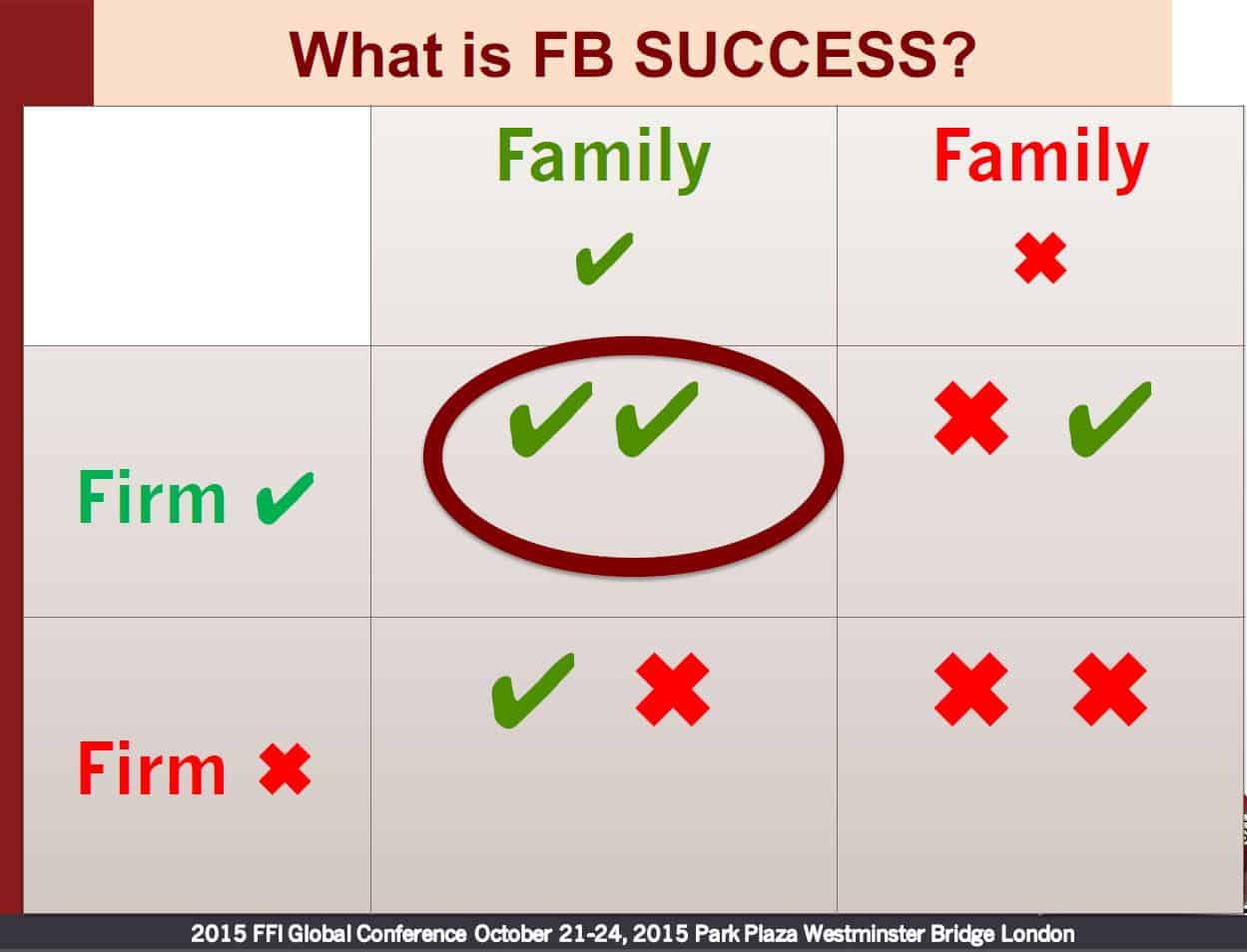
One week ago today, I was in London, attending the Family Firm Institute’s annual conference, enjoying the educational component, taking a course called The Professional’s Toolbox. The instructors used a series of PowerPoint slides over the course of the day, and one of these slides just happens to summarize my view of the “Preferred Embodiment” of family business.  I wanted to insert the image in the text here, but somehow I could only put it at the top of this post. I bit anti-climactic, but I think the point is very clear.

It is so darned simple, it is almost embarassing to share it as something useful, but at the same time, I know that it is forgotten or overlooked by many people, who should know better, far too often.

It is not always easy to achieve, but it is always worth striving for. And it is OK to ask for help when you need it.

(Thanks to Pramodita Sharma and Andrew Hier who taught the course, and one of whom I presume put that slide together)


Steve Legler “gets” business families.
 
He understands the issues that families face, as well as how each family member sees things from their own viewpoint.
 
He specializes in helping business families navigate the difficult areas where the family and the business overlap, by listening to each person’s concerns and ideas.  He then helps the family work together to bridge gaps by building common goals, based on their shared values and vision.
 
His background in family business, his experience running his own family office, along with his education and training in coaching, facilitation, and mediation, make him uniquely suited to the role of advising business families and families of wealth.
 
He is the author of Shift your Family Business (2014), he received his MBA from the Richard  Ivey School of Business (UWO, 1991), is a CFA Charterholder (CFA Institute, 2002), a Family Enterprise Advisor (IFEA 2014), and has received the ACFBA and CFWA accreditations (Family Firm Institute 2014-2015).
 
He prides himself on his ability to help families create the harmony they need to support the legacy they want. To learn how, start by signing up for his monthly newsletter and weekly blogs here.


Understanding AND Agreement

One of my guilty pleasures is to look at different words, whose meanings are often confused, and to take the time to analyze the subtleties in their differences. Sometimes the consequences of this confusion are humorous, and other times they can be more dramatic.

As you can guess from the title of this post, today’s words are understanding, (the noun, i.e. “an understanding”) and agreement. The two words jumped of the screen at me yesterday during a PowerPoint presentation, so I quickly took a picture of the slide with my phone, and I knew that I had my weekly blog topic.

The context within which this subject came up was a course I was attending in London, as part of the annual FFI (Family Firm Institute) conference. FFI offers a great education program, and this class was part of the final course in the ACFBA vertification. (Advanced Certificate in Family Business Advising).

One of the first slides used outlined the “Core Issues underlying Problems in the Family Enterprise System”. The line below this title stated, “Lack of Understanding / Agreement on:…” , following a list of subjects, including “where are we going”, “what is important to us”, “who does what”, “who is the boss”, etc.

The class was only 6 hours long, and there were plenty of important things to cover in our group of about 20 students from at least 10 different countries, so I did not even feel we had time to address my penchant for parsing the differing meanings of “understanding” versus “agreement” with the group.

But I have this blog as an outlet, where I can do this at my own pace, so I was alright.

We can take a few examples right from the slide. In a family business, some family members may not have an understanding of where they are going, and that is an issue worth addressing. Other families may understand perfectly well where they are going, but that doesn’t mean that they agree with the direction!

Along the same lines, a family may “understand” full well “who is the boss”, while completely disagreeing on the choice of that person. I hate to think of how often this is true in real life.

The two examples so far may lead one to believe that understanding must always precede agreement. After all, how can you agree on something without first understanding it? In a logical world, this thinking makes perfect sense.

But we are looking at the world of family business, where logic is often absent. The people who inhabit this world are usually so immersed within it, that they do not even realize how illogical it can be, and they operate on a day-to-day basis not even seeing how some things that others take for granted are completely missing.

My point here is that many family businesses will operate for years (or even decades) based upon full agreement on questions about “who is the boss” and “where are we going”, without having even a basic “understanding” about the underlying questions like “why”.

They will agree to go along, without the foggiest notion of where they are going. They may not care, they may not think they will be told the truth, they may not think that their questions will be deemed worthy of a response, or someone may be deliberately misleading them about these answers. (Or they may ALL be clueless).

Yesterday’s course was called “The Professional’s Toolbox”, and was designed to equip us with tools that we can use with enterprising families. We looked at ways to help them figure out “where they are going” and “how they planned to get there”.

And I also wanted to add my observations about the importance of having everyone agree on the answers, but also to understand the answers.

Or was it that it is important to understand the answers, and then agree on them?

In a perfect world, they all understand AND agree. That should be the goal. We want to have both the chicken AND the egg.


Steve Legler “gets” business families.
 
He understands the issues that families face, as well as how each family member sees things from their own viewpoint.
 
He specializes in helping business families navigate the difficult areas where the family and the business overlap, by listening to each person’s concerns and ideas.  He then helps the family work together to bridge gaps by building common goals, based on their shared values and vision.
 
His background in family business, his experience running his own family office, along with his education and training in coaching, facilitation, and mediation, make him uniquely suited to the role of advising business families and families of wealth.
 
He is the author of Shift your Family Business (2014), he received his MBA from the Richard  Ivey School of Business (UWO, 1991), is a CFA Charterholder (CFA Institute, 2002), a Family Enterprise Advisor (IFEA 2014), and has received the ACFBA and CFWA accreditations (Family Firm Institute 2014-2015).
 
He prides himself on his ability to help families create the harmony they need to support the legacy they want. To learn how, start by signing up for his monthly newsletter and weekly blogs here.


En juillet, j’avais écrit un blogue qui répondait à une question posée par une participante lors d’une session du cours Triomphe, de l’École d’Entrepreneurship de Beauce, à laquelle j’ai eu le plaisir de participer comme invité.

Cette semaine, en emménageant mon nouveau bureau, j’ai tombé sur le dossier dans lequel j’avais gardé les autres questions auxquelles je n’avais pas eu le temps de répondre, et le “timing” était parfait, puisque j’avais déjà décidé que j’étais dû pour écrire un blogue en français, et je n’avais pas encore trouvé un sujet à mon goût.

J’ai choisi une question venant d’un homme qui approachait la soixantaine, et qui avait des enfants adolescents.

Voici la question: “J’ai deux enfants qui sont trop jeunes pour la relève, mais qui sont intéressés aux affaires, et à être dans l’entreprise dans le futur. Que faire?”

J’aime beaucoup cette question, surtout parce que le questionneur l’a déjà séparée en deux pour moi, ce qui la rend plus facile à répondre. Je m’explique.

Les jeunes sont “intéressés aux affaires”, et ils ont un désir à “être dans l’entreprise” un jour. Remarquons les différences.

Aider nos enfants à développer leurs intérêts, que ce soit aux affaires, aux sports, à la musique, etc., est un des plus gros plaisirs qu’un parent puisse avoir, surtout si le sujet en est un dans lequel le parent a aussi un fort intérêt.

Mais soyons clairs ici; un intérêt “aux affaires”, c’est-à-dire le commerce, les finances, l’achat et la vente de produits et de services (en général), ne doit pas être confondu avec MA compagnie, qui produit et vend quelque chose dans un marché (en particulier).

Je vous suggère fortement d’aider vos enfants à developper et explorer leurs intérêts et leur compréhension de tout ce qui est connecté avec les affaires, l’argent, leurs finances personnelles, le marketing, l’immobilier et les hypothèques, etcetera, sans les limiter aux activités de votre entreprise.

Les opportunités pour ce genre de discussion se produisent litéralement à chaque jour, et dans une variété de circonstances. À la maison, écoutez la télé ensemble, prenez le temps d’enregistrer les épisodes de “Dans l’oeil du dragon” ou Dragon’s Den ou Shark Tank.

Il existe également des émissions axées sur la restauration, l’immobilier, et toutes sortes d’activités commerciales. Il y en a peut-être moins de ces programmes à la télé francophone, mais c’est une autre bonne raison et occasion de faire un peu d’immersion anglophone, ce qui les fera aussi du bien à long terme.

Quand vous vous promenez en ville, en auto ou à pied, remarquez les annonces et les commerces, et parlez ensemble des enjeux, des stratégies, des prix, de tout ce que vous voyez.

Les occasions de découvrir et de développer les forces et les intérêts particuliers de chaque enfant ne cessent de se produire. Il s’agit simplement de les reconnaître et d’entamer une discussion.

“Pourquoi McDo met l’emphase sur ses trios? Est-ce qu’on sauve vraiment de l’argent en choisissant le trio versus l’achat des trois items séparément?” Et, “mais pourquoi ils veulent me faire ‘sauver’ de l’argent quand ils essayent de ‘faire’ de l’argent sur la vente?”

Avec ces discussions, vous apprendrez beaucoup sur vos enfants, et aussi à vos enfants. Et en même temps, ils deviendront, malgré eux, ce qu’on appelle en anglais “financially literate”, c’est-à-dire, ils seront plus à l’aise avec tous les sujets entourant l’argent et les affaires.

Selon moi, c’est un des plus beaux cadeaux qu’on peut offrir à nos enfants, même s’ils décident un jour de poursuivre leur carrière dans un autre domaine.

Si les enfants démontrent un jour un désir de devenir entrepreneur et de se lancer en affaires, vous pourrez certainement regarder la possibilité de les engager dans votre entreprise. Mais ne soyez pas surpris ou déçu s’ils décident plutôt un autre marché ou opportunité, qui s’enligne plus avec leurs intérêts et forces.

Votre entreprise est un actif que vous pouvez vendre à quelqu’un qui ne fait pas partie de votre famille. Après, si vous voulez aider vos enfants à se lancer en affaires dans une business qui les motive vraiment, allez-y. Et ça sera leur entreprise!