
If Only So-and-So Would Just…

This week we’re going to look at a subject that’s never far away when families get together and things don’t go exactly according to plan.
We’re going to start with a LinkedIn post from one friend and colleague from California and then include a parable from another in Australia.
We all want everything to go well all the time, and because life happens, sometimes things don’t turn out the way we’d hoped.
So, what then?
Well, in too many families, the first thing that happens is finger pointing to find the one person who is at fault, so we can blame them.
Of course, none of it is ever MY fault!
Section 01
Tech Issues on a Live Webinar
Emily Bouchard shared a story on LinkedIn that she started with what she stated was a line she uses frequently when working with families:
“Everyone is at fault, and no one is to blame.”
I immediately sent myself an email with that quote and put it into my “Blog Ideas” folder for safe keeping for a few weeks.
She went on to explain that she and a colleague had put on a live webinar the day before and where some tech glitches lead to a sub-optimal experience.
She then owned her part of it and noted that she invited her team to do the same.
Doing this requires a certain willingness to be vulnerable and that’s a leadership skill that most teammates appreciate.
She could probably have skipped over the part she played in it and focused on either the technology or some other person.
But she didn’t, because like so many problems, it was actually the result of a bunch of little things that just happened to come together at the wrong time.
Section 02
How Would a Sports Team Handle This?
This got me thinking about sports teams who compete to win every game but always end up losing on at least some occasions.
It can be tempting to point out one person’s miscue, but every game presents many opportunities for someone to influence the result.
After the game, during the coach’s press conference, does he usually call out a single person who made a mistake as the cause of the loss, or does he mention that there were a few areas where the team could have performed better?
What about the players when they answer reporters’ questions?
Every now and then, some will misspeak and call out a particular teammate, and then we never hear the end of the fact that they threw someone under the proverbial bus, even though there was surely lots of blame to go around.
Start the trade rumours, because that won’t play well in the locker room.

Section 03
The Family as a Team? Yes, Again!
A few weeks ago, in On Connection, Belonging and Learning in Families, I brought up the concept of thinking about your family as a team.
There are certainly a lot of potential benefits to treating your family as if they are a sports team, especially if you’re a fan of metaphors like me.
Of course there are other sports comparisons that can be made, and we need to distinguish between everyone being on the same team, as opposed to competing against each other.
As I noted in Kissing your Sister — Playing for a Tie in FamBiz, a family should not be trying to beat each other, and playing for a tie is how a family really wins.
Section 04
A Worthwhile Parable for Families
My Australian friend John Broons shares a great parable about blame in his book, Creating a Thriving Family Business — Progress, Not Perfection.
His story about Somebody, Everybody, Anybody and Nobody is one I even pulled out and read to a family during a meeting I was facilitating with them.
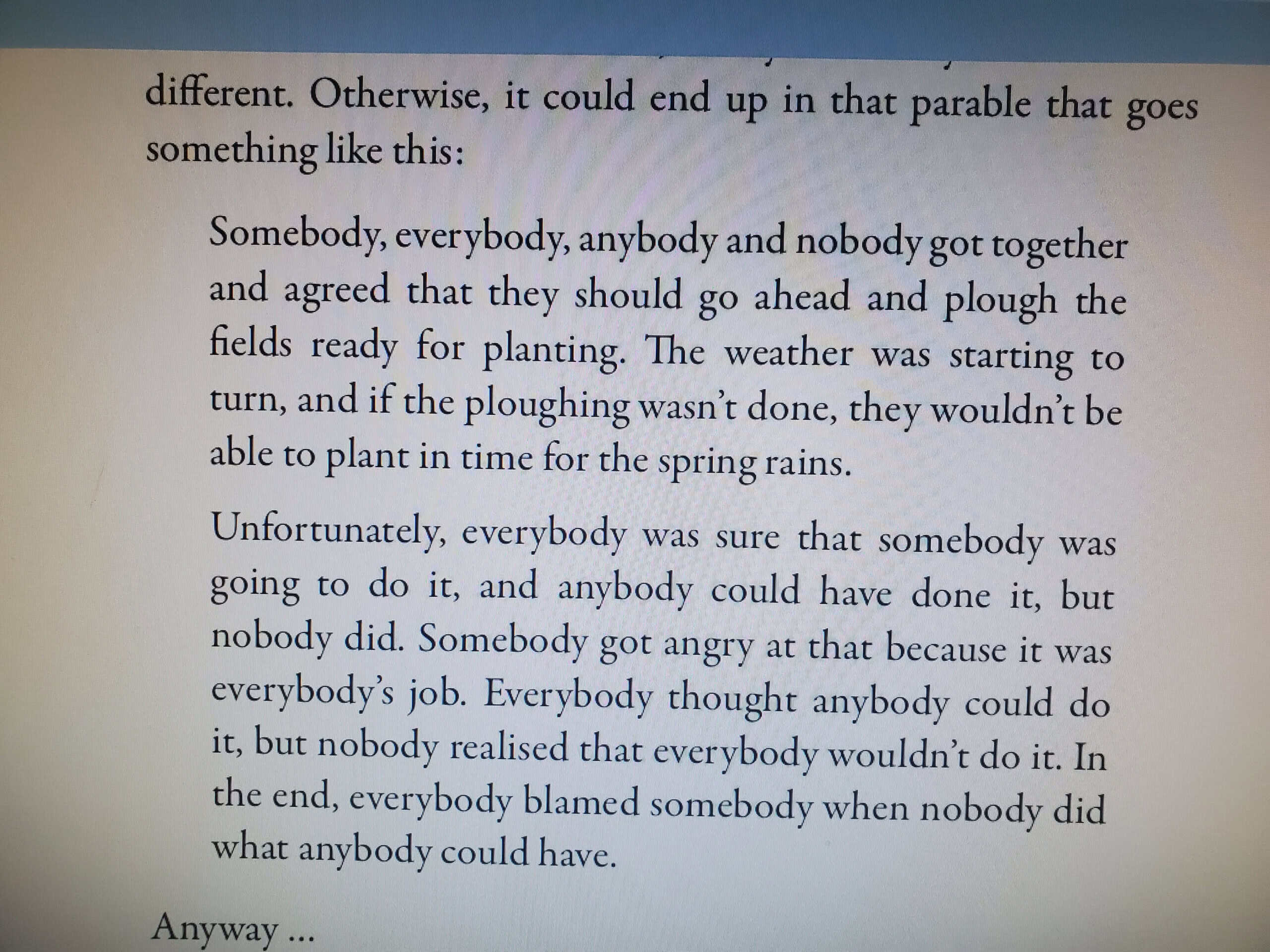
It helped me drive home a point about being more specific when assigning a particular task, lest it not get done and then spark the blame game.
Section 05
Plenty of Blame to Go Around
One of the aspects of trying to find the one to blame that really bothers me is that it’s always backward looking.
Dwelling on how things got where they are and who caused us to be in a sub-optimal place is not productive in getting us out of where we are.
If you want to examine everything to see who’s responsible for a situation, you will probably end up uncovering many contributors.
Can we instead look to the future and how we can organize ourselves so we can improve our situation?
Yes please.
At A Glance
From Blame to Building Forward
Tap each card to reveal the shift.
+Shift IReframe the Fault
“Everyone is at fault, and no one is to blame.” — Emily Bouchard
+Shift IIOwn Your Part First
“Doing this requires a certain willingness to be vulnerable and that’s a leadership skill most teammates appreciate.”
+Shift IIIDon’t Throw a Teammate Under the Bus
“There was surely lots of blame to go around… that won’t play well in the locker room.”
+Shift IVPlay for the Same Team
“A family should not be trying to beat each other, and playing for a tie is how a family really wins.”
+Shift VBe Specific About Who Does What
“Being more specific when assigning a particular task, lest it not get done and then spark the blame game.”
+Shift VILook Forward, Not Back
“Can we instead look to the future and how we can organize ourselves so we can improve our situation? Yes please.”