Great Expectations in Enterprising Families
Writing this blog every week means I’m constantly on the lookout for interesting viewpoints to expound upon in this space.
I usually collect ideas and set them aside for a time, and while they germinate in my head (and in an email folder) sometimes a new slant comes up and allows me to almost kill two birds with one stone.
So it is this week, with a look at how important expectations can be in a family that’s in a position to transition significant wealth to the next generation.
PPI Strikes Again
I lost count a long time ago as to how many of my posts have been inspired by my participation in events and webinars put on by the Purposeful Planning Institute (PPI).
So once again in early July the thought leader guests (Coaches Mimi Ramsey and Stephanie Hardwick) did not disappoint when they brought up “expectations”.
The money quote, which I hesitate to qualify as a quote since I’m not sure I got it verbatim, was that “unmet expectations are the biggest source of conflict”.
Wow, so true. Can you think of anything that causes more; I can’t.
Family Enterprises Are Rife with Examples
Anyone who works with business families is familiar with the common refrain that they need to work on improving their communication, and that’s certainly true in almost all cases.
What they neglect to point out is that very often some of the most glaring gaps in their communication are around the very subject of expectations of one another.
A related idea that fits right into this topic is that loaded word, “assumptions”; i.e. everyone makes their own assumptions about how things are, and what’s expected, without ever checking to see if other people view things the same way.
Expectations are typically somewhere high up on the list.
When a New Slant is Actually an Old Slant
I noted off the top that I love it when a subject comes up from two different angles, allowing me to tie them together in one blog.
The part I just related, about unmet expectations and conflict, was quite recent, but the other angle has been simmering in the back of my mind for quite a while.
This piece is a bit more involved, and it also comes from someone I first met thanks to PPI, none other than David York.
If his name sounds familiar, it may be because I’ve mentioned him before, including two whole blogs, each devoted entirely to one of his nuggets of wisdom. See Doing Better than the 4 D’s and Family Wealth Dynamite: One Stick or Two? I’m clearly a big fan.
Three Key Questions for Building Stewardship
Wanting to make sure I got York’s three questions exactly right, to quote them here, as they are so simple and so fundamental, I looked through my accumulation of various slide decks from presentations and happily hit the jackpot when I found that one particular slide, which read:
Six Keys for Creating Stewards:
5. Remove the Ambiguity
– What can I expect?
– What should I not expect?
– What is expected of me?
Rising Generation Family Members Want Clarity
I think that anyone who puts themselves in the shoes of a person growing up in an enterprising family, or a family of wealth, can agree that having clear answers to these questions would go a long way towards giving them clarity on some pretty fundamental topics that will affect their lives in so many ways.
When parents do not communicate the answers to these questions, they leave their children in a position where they each begin to make their own assumptions as to what the expectations are.
As you might imagine, the various assumptions will often be quite different from what the parents are expecting, leading to unmet expectations, which invariably lead to: conflict.
Turning Expectations into Agreement
Back to the coaches on the PPI call I began with; they noted that what families should aim for is turning expectations into agreement.
In order to do that, like York says, you need to have conversations to clarify what those expectations are, and, as he notes, what they are not.
And let’s not forget York’s last point, about what the parents expect of their offspring.
None of these things are automatically known, they need to be discussed, and these conversations are not always easy to have, nor obvious to start.
They cannot be ignored forever, and a coach can help you.
Social Capital in the FamBiz World
The Human Need for Connection
Sometimes I surprise myself with a blog topic that feels like I’ve written about before, but discover that it’s still virgin territory.
This is one such post.
Given that most of my coaching sessions with clients is spent on their relationships with other people, usually family members, and that my latest book is specifically about family systems theory, I’m actually a bit shocked that I haven’t yet addressed the subject of “social capital” in my blog.
Maybe it’s just a term whose time has come.
My Personal Social Capital “A-Ha”
Last week in An Uplifting Week, at Sea Level, we looked at the recent RendeZoom I had attended with a few hundred colleagues, who I affectionately called “my tribe”.
And even though this annual event was held virtually this year, I still felt very close to many of the people who attended with me.
That whole experience put the idea of “social capital” onto my radar, and yet I wasn’t sure that the term was well understood.
I mentioned it to my coach, and even she wasn’t sure what I meant when I noted that I felt I had lots of social capital.
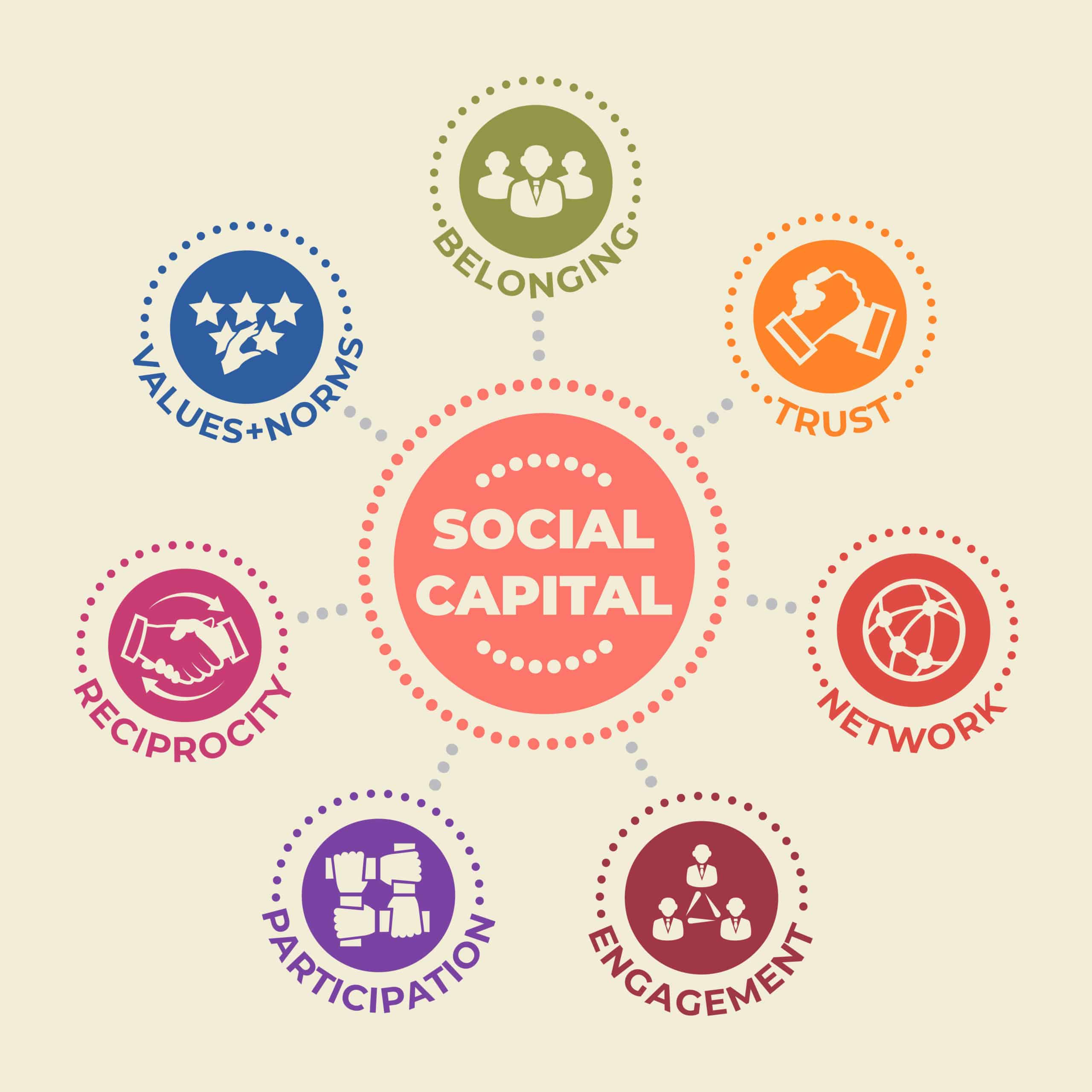
Sometimes you find inspiration in unexpected places, and when I searched Shutterstock for an image to accompany this post, entering “social capital” as the search term, I got a nice surprise; clearly I was not the only person who ever considered this term.
A Whole List of Sub-Topics
The image I chose contains a slew of ideas that make it pretty easy to get what I’m driving at:
Belonging, Network, Participation, Trust,
Engagement, Reciprocity, Values-Norms.
I think it’s simple enough to understand how in a large group of professional colleagues, especially in a “horizontal” field where many disciplines are represented, social capital can be important in maximizing what one can get out of being a member.
But where I really want to go with this is into individual families and their social capital, because there’s some good stuff to look at there too.
External Social Capital in Enterprising Families
Family business leaders, by virtue of their status and accumulated experience, naturally develop networks of people with whom they interact on a regular basis over the years.
These relationships are often based on trust, and that trust can and should be transitioned from one generation of the family to the next.
This becomes one of the important assets that a family enterprise has, and smart, proactive families leverage this social capital, which often becomes one of the key advantages that family businesses have.
What About WITHIN the Family?
But as much as this social capital, from the family to the outside world, can be something worth cultivating, I want to talk about an often neglected area of “social capital”, namely the relationships within the family itself.
Not every family member is cut out for this role, but this field now has enough research behind it to make it clear that a “family champion” is almost always present in families who manage to keep the family together over a series of generations.
There’s a certain amount of intentional effort that must be given to the roles of engaging the whole family in the constant, long-term pursuit of its longevity as a cohesive unit.
Different Leadership Styles Come into Play
When you think about family businesses and their leadership, it’s natural to think about the person at the head of the business.
The leaders I’m talking about here are different, but at some points in the evolution of the family the roles can both be held by one person.
The “Family Leader” is the one who undertakes the role of connecting with the family members, whether or not they are involved in the operations of the business.
Their concern spans areas like Belonging, Participation, and Engagement, and these leaders are constantly building Trust along the way.
Proactive, Intentional Steps, Over and Over
Such family leaders are very much like a “team captain” in sports, often demonstrating quiet leadership as much thanks to “who they are” as to “what they do”.
But what they do, while often hard to describe because there are so many intangibles, is keep the family working together, because they know deep down how important that is for the greater good of everyone.
A family’s legacy is as much about people as it is about assets, after all. See Is Your Continuity PAL in Danger?
And that’s all about social capital.
Every summer since 2014 around this time, I get to write one of my favourite and yet most difficult blog posts.
That’s because in late July every year, the Purposeful Planning Institute holds it annual conference, called Rendez Vous.
As you probably guessed, there was no “in person” version this year, so instead, I’m now coming down off the high of “RendeZoom”!
The experience was different, of course, as I didn’t have to fly to Denver this time, and instead got to enjoy it from my cottage near the Northumberland Strait in New Brunswick.
So Much Great Content
What makes this particular blog so hard to write is that there’s just WAY too much great content that I want to share, and even though we weren’t physically together this time, that didn’t change.
We also had a lot of the same “magnetic PPI vibe” that attendees are familiar with, but that is sometimes hard to describe to those who have yet to experience it.
There were some new ways to interact that were designed to replicate the in-person feelings, which is tough to do, but in many ways the experience was even richer in other ways, so on balance, there was not much lost in the “translation” to the virtual world.
A Random Highlight Reel
One way to overcome the difficulty in capturing a week’s worth of learning is to just look over my notes and share some of the things that stuck with me and that I think are worth sharing here.
It’s a lot more “random” than most of my blogs, yet it still feels useful and is definitely heartfelt.
Speaking of heartfelt, I’d invite anyone whose path I crossed during RendeZoom to please follow up with me to deepen our connection, as I’d love to chat more over a one-on-one Zoom call.
The week gave me a new appreciation for my “social capital” and I’m trying to find even more ways to keep “sharpening that saw” of mine.
Likewise, if you’ve never attended, and are intrigued by what PPI has going on, please reach out for a call too.

Steve’s Top 7 Take-Aways
-
Motivational Interviewing
I knew very little about the area of “motivational interviewing”, so the breakout session on the subject was something I approached with intrigue.
What I discovered is that it feels like a close cousin of coaching and that there are skills and techniques I can learn from it that will make me an even better listener, coach, and facilitator.
-
Inspired by Gandhi
My friend Jamie Forbes shared some very personal stories about his life and I applaud his courage for doing so (and he was from alone in this regard!).
But I need to thank him for reminding me of this Gandhi quote:
“Happiness is when what you think, what you say, and what you do are in harmony”
Amen.
-
Facilitation from Many Angles
Matt Wesley capped off the week with a discussion about the many facets of facilitation, many of which resonated with me and how I see myself in that role.
From being the one who brings calm, to integrating the family’s stories, to connecting the dots for them, there are many ways we help bring out their best.
-
How to “Move Forward”
Ian McDermott once again graces my list this year, for simply reminding me that just trying to figure out how to “move forward” is often the best way to look at a challenging situation, whether personally or when working with clients.
-
Made for “These Times”
I don’t remember whom to credit for this one, but thanks for the question “How are you MADE for these times as a _______?”
Still reflecting on this one…
-
From Entitlement to Expectations
In a discussion around the theme of entitlement, we ended up switching things around and instead focused on the parents and their need to clarify their expectations.
-
Building Bridges, or Building Boats
Matt Wesley again to close…
Sometimes it’s time to build a bridge, and sometimes it’s time to build a boat.
Thanks Matt, and everyone else who inspired me once again, it was another Rendez Vous to be remembered.
Rendez Vous 2021 – Somehow, Somewhere
It’s too early to say for sure that we’ll be back together in person in Denver next year, and I sure hope that will be realistic.
No matter how or where, though, I know I will be back, and I’m looking forward to spending more quality time with my tribe.
A Story about Distributed Leadership
So many family businesses face similar issues, especially when they’re faced with the challenge of moving from the founding generation to “G2”.
The stories are never identical, but the idea of going from one person who loves to control everything, to a group of people working together is something that trips up many families.
And sometimes when the resulting business is very successful and it becomes a very large entity, the problems this creates can become huge too.
A Case Shared with a Peer Group
I’m privileged to belong to a number of peer groups where we talk about cases together, so we can learn from each other and sometimes get ideas when we’re stuck.
This week’s blog is about one such case, or maybe it was two (?)
Well, it was one such episode of sharing, that happened to cover two family business situations, that shared many similarities.
This was a few months ago, so the details aren’t necessarily “fresh”, but since I wouldn’t want to divulge too much, it’s better that way.
Also, the point about the “non-concentric circles” is the one I want to make, so the particular case details aren’t really that germane.
Replacing One Dominant Central Leader
The case(s) featured one main founder who had a family of successors, none of whom had anywhere near the potential to succeed their father in all of his success, which isn’t at all uncommon.
As noted, when the success is really rapid (within one adult lifetime) and large (thousands of employees, global presence) it’s almost impossible to expect that any one of the offspring will be able to simply step into the founder’s shoes.
It would likely be a recipe for failure in both the business, and then also the family, if they even tried.
In the case we were presented, that founder was the main leader in all three circles: Business, Family, and Ownership.
See Three Circles + Seven Sectors = One A-Ha Moment (from 7 years ago)
Leadership Doesn’t Show Up “Overnight”
The rising generation, who were all adults when Dad passed away suddenly, were all involved somewhere in the businesses, but none of them had the experience or the gravitas to take the helm, or helms, that their father held.
My colleague who presented the case had been involved in getting things on track so that the company would thrive and the family could remain successful in owning the business for the long term.
For the business, there were already lots of qualified non-family leaders in many places, so the business did not suffer much.
The ownership was also pretty clear, in terms of who rightfully owned what percentages of the shares, and it was relatively simple.
How about the family?

The Family Circle: A “Left-Over” Concern?
If you have any experience with family businesses, you’ll likely know that the family is often the last concern, because everybody loves each other and so let’s just concentrate on making money and they’ll all be happy.
I hope readers recognize that much of that last sentence was written in jest.
A better way to put it is that the family is never a problem, until it is. And then it’s usually a huge problem.
Thankfully this family brought in some top advisors to work with them to make sure that the family problems remained at bay.
Many Opportunities for Many Leaders
Over the months and years that the consultants worked with the family, they ended up developing a number of opportunities for a handful of family members to step up into leadership roles.
They formed a family council, and a number of committees emerged from that structure, with different family members assuming key roles.
An “ownership council” was also created, resulting in the rising generation of the family learning how to work together in a variety of new ways.
Whereas their father was at the center of all of these circles during his lifetime, the next generation converted that to a series of different circles, with different people taking leadership roles.
Ultimately, this results in a much more stable structure for the family, the ownership, and the businesses that they own.
Serendipitous Timing
As I’ve noted previously, my social media posting is done by a third party, so I never know the timing of the content that I’ve produced showing up on my feeds.
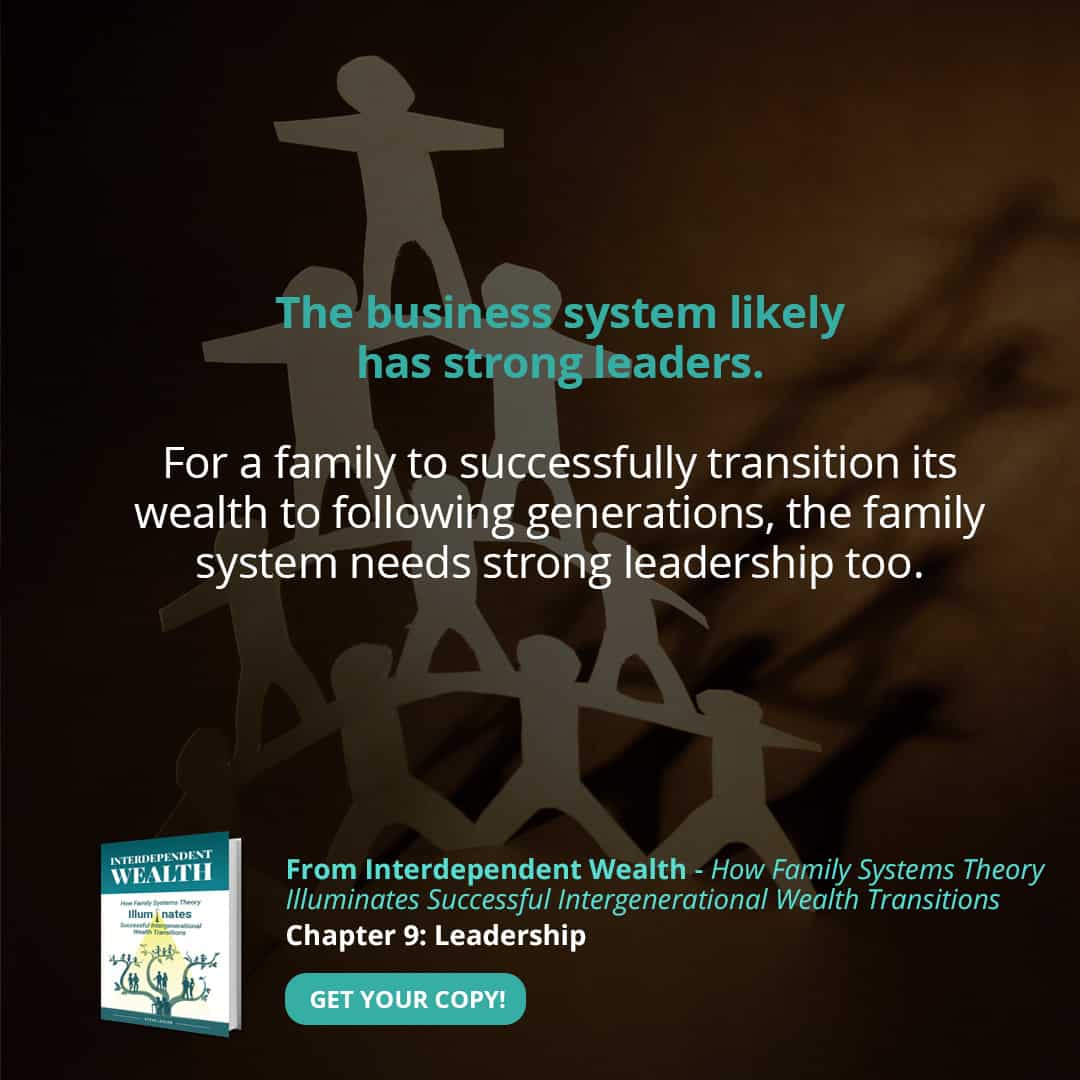
Last week a post promoting my latest book appeared, reading:
The business system likely has strong leaders
For a family to successfully transition its wealth to following generations, the family system needs strong leadership too
Good timing!
From Paddling Hard to Going with the Flow
Summer is in full swing and with it come some activities that we look forward to because we haven’t been able to do them for a while.
For me, one of those is kayaking on the tidal river at my cottage in New Brunswick, where I get in touch with nature while lazily paddling around looking at the sky in search of the occasional bald eagle.
Having recently arrived here, I received a text message from a friend asking me if I was enjoying myself, “floating downstream” on my kayak.
Regular readers won’t be surprised that something so simple would become the inspiration for a blog post.
Tidal Rivers and Delayed Gratification
While I’m no expert in tidal rivers, I can tell you that sometimes this river flows towards the ocean about a kilometer away, and then a few hours later it will flow in the other direction.
When heading out from the dock for a kayaking excursion, I always make sure to go into the flow of the current, so that I can coast back home, going “downstream”.
My wife and I learned this lesson the hard way years ago, when we went rollerblading, not realizing that we had the wind at our backs, only to turn around to go back home and quickly realize our misfortune of having a strong headwind to deal with.
It’s a simple example of delayed gratification, which I love to preach. See Marshmallows and Filet Mignon
Climbing the Hill and Coasting Back Down
The flowing river metaphor is similar to the uphill / downhill one that we hear about when talking about where people are in their life cycle.
Older people are described as “over the hill” while the younger ones are continually “climbing” towards the top. Getting to the top and remaining there are the goal, we’re led to believe, and in many ways that makes sense.
But in the same way that I like to save the coasting part of my kayak trips to the end, why don’t we look at life the same way?
And if we’re part of a business family, isn’t there a way that one generation’s trip down the other side of the hill can serve as a boost to the next generation’s rise?
Capitalizing on the Strengths of Each Generation
The “rising generation”, as people like me have been referring to them for some time now, typically have more energy to devote to building their lives and careers, while their elders will normally have more experience.
Similarly, the younger members of a family will be more comfortable with technology, while the senior family members will often have a lot more contacts and long-standing important relationships that they can leverage.
Smart families figure out how to make the most of these complementary strengths, which takes a certain amount of self-knowledge and understanding, along with the ability to set egos aside for the common good of the family.
Stepping Away from the Top Spot
The ego component varies from one family to the next, but seems to be rather prevalent in cases where it’s the business founder who wants to remain in charge well past the point where their leadership is what’s best for the business.
Somehow once we get past that first generation transitioning to the second, it’s less of an issue when going from G2 to G3, and then G3 to G4 and so on.
Playing with this hill metaphor in my head, I’m picturing someone stepping off the top of the hill while pulling on a rope, which in turn is helping someone make their way to the top.
I guess there’d need to be some sort of pulley or rappelling device at the top for this to make sense.
Many Years in the Making
I don’t want to give the impression that generational transitions should take place quickly. In fact, properly planned and executed changes in leadership will often take years.
That’s because while we think of these situations as singular events, there are actually transitions happening at several different levels.
There needs to be a lot of coordination to properly transfer all of the knowledge of the retiring leader, as well as the authority, which all takes time, and we haven’t even begun to talk about ownership.
So it’s best to get started early, and be sure to check which way the water’s flowing before you take off.
Capacity vs. Capability
Sometimes when two words start with the same few letters, people get them mixed up, not noticing the nuances in their meanings.
A couple of words that certainly fall into that category are “capability” and “capacity”.
This week I want to explore them a bit, from a business family perspective.
From Ability to Capability
Before we even get to “capability”, we should probably back up a bit and start with “ability”, to make sure we grasp that simpler concept first.
Ability is about what you can do, which you know that you can do because you’ve already done it, at least once.
Capability is more about potential to do something, and as we all know, even though you once were able to do something, that doesn’t mean that you’re still capable of doing it again now.
Ready, Willing, and Able
In some ways, capability can be summed up by the expression, “ready, willing, and able”. If I’m ready and willing to do something, plus I feel like I can muster the ability, then I at least believe that I have the capability to do that something now.
So if you know how to do something and you add some effort to that ability you’re now essentially ready to test out your capability, and can hopefully demonstrate that you can accomplish a task with a certain regularity.
With practice, you can hopefully get pretty good at it, to the point where others recognize that capability in you. You’re off to the races, right?
What About Capacity?
I think that there’s another level that you’ll want to get to that’s higher than simply developing capability, and that’s to increase your capacity to do important things.
The part of the definition of the word “capacity” that I think we should concentrate on when thinking about this is the “volume” aspect.
When talking about a container, whether it’s an aquarium, an airplane, or a football stadium, we can ask about what its capacity is, when we want to know how much it can hold when full.
From Capability to Capacity
So if we go back to the capability discussion, we were getting good at doing something over and over, and now we want to see how much of it we can do.
But we don’t want to do this for everything, we really need to pick our spots and develop our capacity for doing things that are truly important.
And when we’re talking about business families, what’s more important than everyone knowing how to get along and work together?
Families who have succeeded in growing their businesses and wealth AND in transitioning them to the next generation have almost always developed that capacity to work together somewhere along the line, whether they realized that that was what they were doing or not.
Contagious Capability Grows to Family Capacity
The great thing about a family is that every member has different skills and abilities.
It might not always be obvious how some family members can contribute to the business family, but if there are family members who are ready and willing, there should always be some effort made into finding a place for their abilities to contribute.
When you take the individual abilities, work on them so they become true capabilities, and then bring the people together with the right attitude to collaborate, you can develop the capacity for long term success.
The overall capacity of a family comes from the combination of all of its members’ capabilities, and that capacity can be way more than the sum of its parts.
Practice, Resilience, Guidance
Families who have succeeded at this almost never just stumble into that success. Working together with family members can be wonderful, and it can be frustrating too.
It takes effort, and plenty of practice to get it all right.
There will be plenty of trial and error along the way, so the family will need to develop its resilience.
And, importantly, few families get this right all by themselves; they will almost always have someone from outside the family to guide them, especially at key stages.
Whether it’s a family business consultant, a facilitator or coach, it really doesn’t matter, and ideally it’s someone who combines these skills.
Successful multigenerational families have all developed their capacity to work together over time.
Can you?
Book a Free Introductory Call